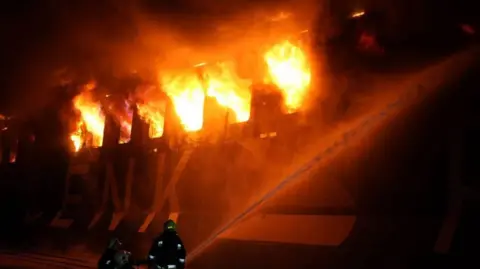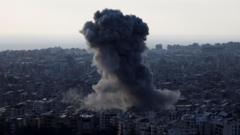
Israel launched multiple air strikes on Hezbollah positions located in the southern suburbs of Beirut on Sunday, igniting a fresh wave of tensions that threatens the fragile peace established five months ago. The Israeli military justified the attacks by claiming that the targeted building was used for storing "precision-guided missiles," which it deemed a direct threat to Israel's national security.
In light of the strike, the Lebanese presidency issued a statement condemning the Israeli actions and urged the United States and France—who mediated the ceasefire last November—to intervene and prevent further aggression. This incident marks the first air strike on the Dahieh area since Israel’s last attack nearly a month ago, signaling a potential shift in the ongoing hostilities.
While Israeli officials allege that Hezbollah has violated the ceasefire by amassing military resources, Western intelligence suggests that Hezbollah has largely adhered to the agreement. Nonetheless, Israel has conducted nearly daily airstrikes targeting sites it claims are linked to Hezbollah.
Despite the evacuation order issued prior to the strikes, which was part of standard protocol for such operations, Lebanon’s Civil Defence reported no casualties, with rescue teams successfully extinguishing the subsequent fire on the damaged site.
Lebanese President Joseph Aoun called for an immediate halt to Israeli attacks, emphasizing the responsibility of the United States and France to maintain peace in the region. “Israel's continued actions will provoke instability and elevate security threats,” his statement read.
Israel's Prime Minister Benjamin Netanyahu reaffirmed that the government would not permit Hezbollah to gain strength, stating definitively that the neighborhoods in Beirut would not serve as safe havens for the group. Meanwhile, Jeanine Hennis-Plasschaert, UN Special Coordinator for Lebanon, expressed grave concerns over the escalating violence and the need for both sides to respect the terms of the ceasefire.
This recent episode emerges against the backdrop of an already strained situation, following prior Israeli strikes that resulted in casualties, including the deaths of four individuals connected to Hezbollah. The continued cycle of violence raises fears of a return to widespread conflict in the region.