
In brief
Luis Manuel Otero Alcántara, 38, leader of Cuba’s San Isidro Movement, escaped to the United States following a harsh five‑year sentence in Guanajay. He arrived at Miami airport surrounded by supporters and performed the anti‑government “L” symbol, a sign of liberty. The Cuban government claims the movement is financed by Washington, a charge the dissidents deny. The move deepens longstanding tensions between Havana and the U.S., as diplomatic friction has escalated under recent administrations. The exodus underscores the escalating pressure on Cuba’s revolutionary regime and its impact on U.S.-Cuba relations.
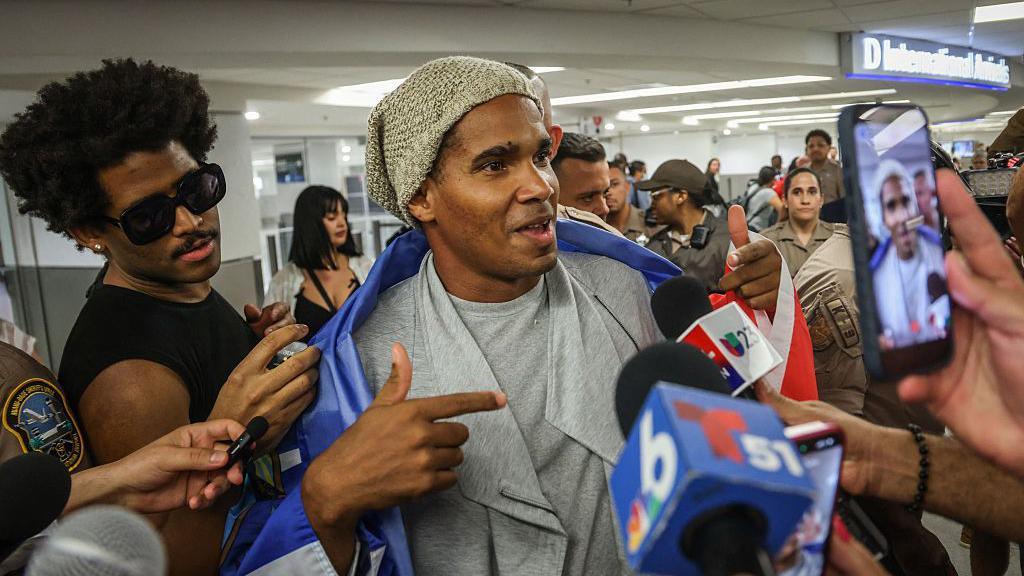
After a five‑year hard‑sentence in the Guanajay maximum‑security prison, Luis Manuel Otero Alcántara, 38, has successfully departed Cuba and arrived at Miami airport, where he was met by a crowd of supporters.
Otero Alcántara, the outspoken head of the San Isidro Movement – a collective of artists, journalists and intellectuals – stated after his arrival: “The dictatorship has to end. The Castro dynasty should end – as long as a Castro remains in power, corruption will continue.”
According to Cuban authorities, the San Isidro Movement is allegedly funded by U.S. agencies, a claim the movement rejects. Members say they face frequent surveillance, arbitrary detentions and outright harassment by security forces.
In recent days Cuban officials kept Otero’s location undisclosed while the United States approved a parole request. This development follows ongoing diplomatic friction between the two countries, intensified by recent U.S. sanctions aimed at hardening pressure on the Cuban regime.
U.S. Secretary of State Marco Rubio condemned the criminal persecution of Otero: “This dissident’s only ‘crime’ is refusing to remain silent and demanding basic freedoms denied to Cubans for almost seventy years.” He added that the U.S. will never accept the narrative that the Cuban government can suppress civil liberties without international reproach.
The tensions between Washington and Havana have further escalated over the past months, with the U.S. threatening various military options, imposing severe sanctions and tightening an oil blockade that has worsened Cuba’s fuel shortage and food crisis. The U.S. also recently sought to indict former Cuban leader Raúl Castro over a 1996 plane downing, a move that has elicited condemnation from Russia and China.
Several Cuban citizens visiting the U.S. or elsewhere have seen the country’s transformation: tourism has fallen dramatically, with fewer than 360,000 visitors to Cuba in the first five months of 2026 – nearly a 60% drop from previous years. The exodus of dissidents such as Otero further highlights the need for change in Cuba’s political landscape.
