In brief
FIFA has appointed a disciplinary prosecutor to investigate the conduct of Argentine players and staff after the 1‑0 loss to Spain in the 2026 World Cup final. The investigation will focus on accusations of assault against Spain players and unsporting conduct under Article 14 of the FIFA Disciplinary Code, targeting players Nahuel Molina and Leandro Paredes, assistant coach Roberto Ayala, and teammate Thiago Almada. Sanctions under the code include a minimum three‑match ban for assault and a minimum one‑match suspension for unsporting behaviour. Argentina has already faced multiple incidents during the tournament, including a banner supporting claims to the Falklands and alleged discrimination, leading FIFA to consider a broader disciplinary inquiry against the national association.
FIFA has opened disciplinary proceedings against Argentina following the team's post‑final conduct against Spain in the 2026 World Cup.
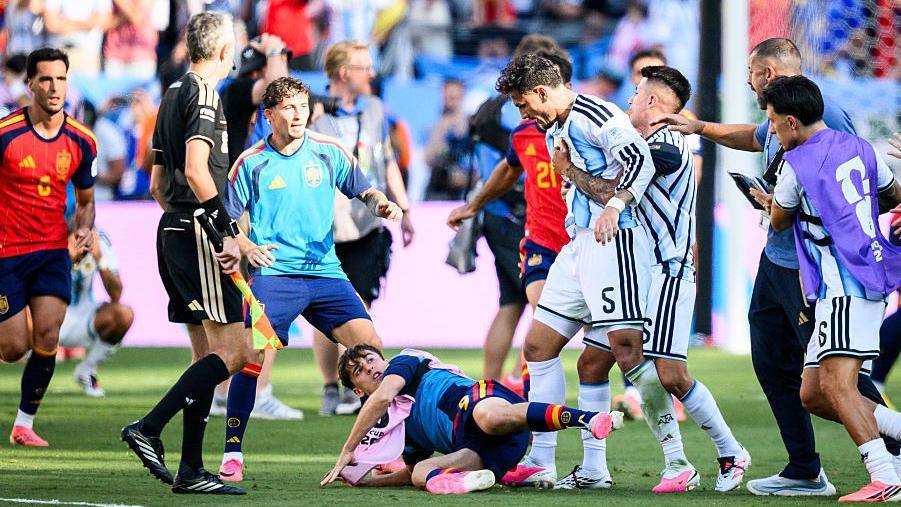
Last week FIFA appointed a disciplinary and ethics prosecutor to investigate incidents that erupted after the final whistle at the New York N.J. Stadium. Multiple Argentine players and staff were involved in altercations with Spanish players after Finland’s 1‑0 defeat.
The prosecutor has identified several possible violations under Article 14 of FIFA’s Disciplinary Code. Players Nahuel Molina (two counts) and Leandro Paredes (three counts) and assistant coach Roberto Ayala (one count) are recommended for alleged assault. Molina may also face an unsporting‑behaviour charge. Thiago Almada and Spanish midfielder Gavi have been named as witnesses or co‑suspects for the same breach.
Under FIFA’s code, assault can lead to a minimum three‑match suspension while unsporting conduct incurs at least a one‑match ban.
In addition, the Argentine Football Association faces disciplinary action for a range of infractions throughout the tournament, including using the event to display non‑sporting demonstrations (Article 13), team misconduct (Article 14), discrimination and racist abuse (Article 15), and breaches of match order and security (Article 17). These concerns stem from chants, gestures, delayed kick‑offs, inappropriate banners, and spectator behaviour.
One notable episode came during the semi‑final versus England, where Argentina displayed a banner proclaiming “Las Malvinas son Argentinas” (“The Falklands are Argentine”). This display attracted scrutiny for political messaging at a sporting event.