
In brief
The discovery, named "Yana" after her finding site, highlights the impact of climate change on permafrost and its historical treasures.
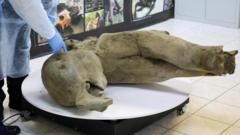
The chilling grasp of Siberian permafrost has unveiled a stunning scientific find: the remains of a 50,000-year-old baby mammoth named "Yana." Discovered in the remote Yakutia region, Yana is celebrated as the most comprehensively preserved mammoth carcass known to date. Weighing over 100 kilograms (approximately 15 stone) and measuring about 120 centimeters in height and 200 centimeters in length, Yana is believed to have been just one year old at the time of her untimely demise.The mammoth's remains were unearthed this summer in the Batagaika crater, recognized as the largest permafrost crater globally. Local residents, fortunate enough to spot the thawing carcass, constructed a makeshift stretcher to transport it safely from its icy resting place. According to Maxim Cherpasov, head of the Lazarev Mammoth Museum Laboratory, their timely discovery was key: "They saw that the mammoth had almost completely thawed out."While sections of Yana's forelimbs had succumbed to scavengers, her head remains in exceptional condition, providing researchers with critical insights. Gavril Novgorodov, a museum researcher, speculated that the mammoth may have become trapped in a swamp, leading to her exceptional preservation over millennia. Currently, scientists at the North-Eastern Federal University in Yakutsk are conducting tests to establish the precise timeline of Yana's life.This remarkable find is one of many noteworthy prehistoric discoveries in Russia's permafrost recently, as rising temperatures continue to impact frozen landscapes. Just last month, scientists revealed remains of a nearly 32,000-year-old sabre-tooth cat, and earlier this year, a 44,000-year-old wolf was also uncovered. These ancient relics provide a captivating glimpse into the Earth's biological past.

