
In brief
A Ukrainian court has made a significant ruling by sentencing Russian soldier Dmitry Kurashov to life in prison for the murder of Ukrainian POW Vitalii Hodniuk. This unprecedented case is rooted in the ongoing conflict and shines light on violations of international law. The trial revealed orders from Russian commanders prioritizing the killing of captured soldiers over humane treatment, amidst mounting evidence of such actions in the war.
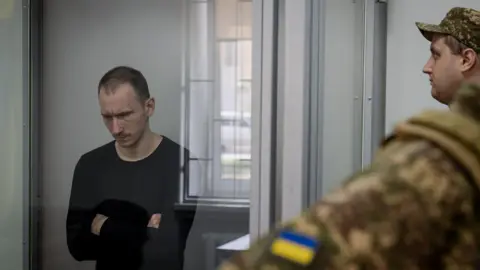
A Ukrainian court has handed down the first jail sentence for life against a Russian soldier accused of killing a Ukrainian prisoner of war.
Dmitry Kurashov, 27, was found guilty of shooting dead Vitalii Hodniuk, a veteran 41-year-old Ukrainian soldier who had surrendered following capture in 2024.
Ukraine's national police said that expert reports, witness testimony and video footage from the scene confirmed that the Russian soldier deliberately killed the POW on the orders of his commanders, who had instructed troops not to take Ukrainian soldiers captive.
In a months-long trial which began earlier this year, the court heard how Kurashov's unit stormed a Ukrainian position in the region of Zaporizhzhia on the morning of 6 January 2024.
The prosecution said that although Hodniuk crawled out of a dugout unarmed and surrendered, Kurashov shot him point-blank with several aimed AK-47 shots – a violation of the laws of war.
Kurashov and the rest of his unit were later overpowered by Ukrainian forces and taken as prisoners of war.
Kurashov initially pleaded guilty but later retracted, saying he had only done so to expedite the trial in the hope that he would be released in a prisoner swap. He maintained it was a Russian medic – who later died – who fired the shots that killed Hodniuk.
His version was refuted by other members of his own unit who were later captured by Ukrainian troops and were also being held as prisoners of war.
They said they saw Hodniuk emerge from the foxhole unarmed with his hands up after Kurashov called for Ukrainians to come out of their foxholes and surrender.
Although they did not witness the shooting because there were explosions at the same moment, all three said nobody but Kurashov had been around when they heard the gunshots. One said the medic accused by Kurashov was not present on the scene when the killing occurred.
Kurashov himself never testified. According to court reporters, his lawyer Anna Karpenko said her client sincerely repented and that he believed he had simply been following orders from above not to take any prisoners.
Nikita Manevsky, the prosecutor who pushed for the harshest sentence, had argued Kurashov had showed no remorse and nothing but indifference during the trial.
Earlier this year, Kurashov told the BBC he had joined the Storm V assault unit in exchange for early release from a remote penal colony in Russia where he was serving a sentence for theft. Representatives from the Russian military told the convicts that if they joined the army and went to Ukraine their sentences would be expunged, Kurashov said.
The recruitment of prisoners to fight in the war in Ukraine – which Russia calls a special military operation – is a known practice.
Convicts who sign up are sent to join the generally poorly trained Storm V penal military units.
Its troops are often employed to join meat grinder assaults on the front line – a tactic which sees waves of soldiers push forward relentlessly to try to wear down Ukrainian forces and expose their locations to Russian artillery.
In May the Ukrainian intelligence directorate (HUR) said it had recorded more than 150 cases of battlefield executions of POWs by Russian soldiers since Moscow launched its full-scale invasion of Ukraine in 2022.
Last year the head of the War Department at the Ukrainian Prosecutor-General's Office told the BBC that executions of prisoners of war by Russian forces had clear signs of being part of a policy as they were happening across vast areas.
Ukrainian forces have also been accused of executing Russian prisoners of war, but the number of such claims has been much smaller.



