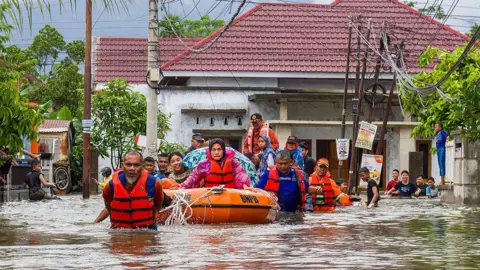
The first of a series of powerful storms has struck the Pacific Northwest, bringing heavy rainfall, swollen rivers, and necessitating high water rescues across the area.
According to the National Weather Service's Weather Prediction Center, several days of heavy rain are projected for western Washington and northwestern Oregon, with the trans-Pacific jet stream leading to intense rainfall along the coast and up to a foot of new snow expected in the northern Rockies of northwestern Wyoming. Flood watches are currently in effect, with warnings of potential flash flooding through midweek.
On Monday night, emergency services in Snohomish County conducted water rescues for individuals trapped at a campsite in Gold Bar, north of Seattle. Crews utilized drones and watercraft to safely extract the stranded individuals, as reported by KOMO-TV.
The Snohomish County Department of Emergency Management warned of ongoing flood warnings as the Skykomish River reached major flood status overnight in Gold Bar. Local police posted social media updates advising residents in the Moonlight Drive area to take precautions and prepare for possible flooding.
In transportation news, officials announced the temporary closure of eastbound Interstate 90 near North Bend due to debris from heavy rains and winds, although the roadway has since been reopened.
As of Tuesday morning, the Seattle office of the weather service indicated that although the atmospheric river system had moved south, it was expected to shift back north, resulting in ongoing heavy rain and increased river flooding.
Portland officials warned commuters to expect the heaviest rainfall coinciding with the Tuesday morning commute, raising concerns for hydroplaning and other dangerous travel conditions.
Additionally, a rapidly advancing storm is set to impact the Upper Midwest, with weather advisories for freezing rain, strong winds, and heavy snow expected across the northern plains. Residents are advised to prepare for tough travel conditions as the weather system heads into the Great Lakes region by Wednesday.