
In brief
In the aftermath of brutal airstrikes in southern Beirut and beyond, local business owners are reeling from substantial losses and are left to ponder how to rebuild their lives and livelihoods amid the widespread destruction. The community awaits support, primarily from Hezbollah, while financial aid and reconstruction plans remain unclear.
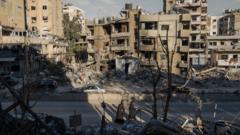
Amid the wreckage of southern Beirut's main commercial street, a shattered sign reading “Spare parts. Jeep Cherokee” serves as a somber reminder of the vibrant car parts dealership that once occupied a now-ruined building. This destruction reflects the broader impact of Israel's heavy bombardment during the recent conflict with Hezbollah, leaving many local businesses demolished and their owners in despair. Imad Abdelhak gazes at the remnants of his car maintenance garage next door, which narrowly escaped the full force of the airstrikes, yet faces an uncertain future as engineers assess the damage. "We believed our neighborhood was safe—ordinary people affected," he lamented. Like many others throughout Lebanon, Abdelhak is grappling with the reality of financial insecurity following the unexpected escalations of violence.The situation is dire for many business proprietors, such as Ibrahim Mortada, who incurred a staggering loss of $20,000 when his car parts store suffered direct damage. “I don't know how we'll survive,” he said, a sentiment echoed by countless others in the war-torn region. Mortada has operated his business for 23 years, and now stands among the debris, uncertain if his livelihood will ever recover.As the dust settles, business owners are hoping for assistance. Hezbollah has promised to assess damage and provide monetary aid for rent and reconstruction, with payouts rumored to be around $5,000 for affected households and up to $8,000 for businesses. However, for many like Niran Ali, whose children’s clothing store was reduced to rubble, real support feels distant. She expressed frustration at the lack of communication, saying, “Nobody has contacted us—neither the government nor any group.”In Nabatieh, Jalal Nasser, who owned a multi-venue complex, now faces an estimated $250,000 in losses. Despite the devastation surrounding him, he strives to share a message of hope by setting up a table outside his former business. "We are waiting for Hezbollah," he remarked, emphasizing the community's reliance on external support.As the World Bank estimates the conflict has inflicted at least $8.5 billion in damages on Lebanon’s economy, business owners are not only battling physical ruin but are also burdened by the strain of a lingering financial crisis and last year’s port explosion. Authorities lament the absence of immediate reconstruction allocations, leaving many anxious that rebuilding efforts will mirror the extensive financial hurdles faced in this latest cycle of violence.“The damage this time is far more extensive than in previous conflicts,” said Nasser Yasin, Lebanon’s environment minister. The International community is concerned that their assistance may not match the scale of destruction, as was the case after the 2006 war.Many residents question not just the likelihood of financial help but also its timing. “We have lost everything," Yusuf Mouzzain, a local shop owner, shared anxiously, calling for urgent assistance from those in power. The future remains uncertain for both businesses and communities; the war that has ravaged their home will require an expansive and collaborative rebuilding effort, slow and uncertain as they wait to see if aid will materialize.
