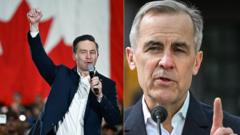
In a remarkable twist in Canadian politics, the upcoming election has morphed into a battleground of ideas amid rising tensions with the United States. At a recent rally in London, Ontario, Liberal leader Mark Carney faced a hostile crowd that reacted with boisterous disapproval as he articulated a narrative centered on the perceived threats from President Trump. "The American agenda is aimed at dividing us for dominance," Carney asserted, emboldening a chorus of supporters who chanted in unison, brandishing Canadian flags.
In contrast, Conservative leader Pierre Poilievre has ignited fervent support from crowds at union halls, leveraging a message that champions both change and national pride in response to U.S. tariff threats. His rallying cry, "Bring it Home," resonates deeply with citizens feeling the economic pinch as the election date approaches. Political analysts suggest the direction of this close race hinges on which party effectively addresses the concerns raised by American policies, particularly under Trump's administration.
As the final countdown of this 36-day campaign unfolds, various polls indicate a tightly contested battle, with the Liberals slightly leading in popularity. Nonetheless, Trump's influence within the election dialogue has been significant, although he was only briefly mentioned in Poilievre's speeches. Rather, the Conservative leader has addressed mounting grievances from voters critical of the Liberal administration, particularly regarding the housing crisis and concerns over crime rates.
Eric and Carri Gionet, residents of Barrie, Ontario, represent a demographic of voters anxious about the future of their children, who are struggling to enter the housing market that they once navigated with ease. This election cycle has witnessed a fluctuating dynamic, with the Conservative party previously enjoying substantial leads—now shuffled by unexpected political upheavals, including Trudeau's departure and Carney's ascent following a turbulent political landscape that has compelled many to reconsider their loyalties.
Influential voter sentiment has also shifted towards Carney, who presents himself as experienced and reliable amid fears tied to U.S. economic policy. However, his candidacy faces skepticism from some quarters, including veteran Conservative voter Gwendolyn Slover, who questions the support for Carney, viewing him merely as a continuation of previous Liberal government policies.
Surrounding these pivotal discussions is the looming question of Canada’s national identity in light of external pressures, with Carney skillfully navigating these treacherous waters as he poses as the steady leader the country needs.
Amid a backdrop of economic uncertainty and dissatisfaction directed toward established governance, innovators among smaller parties, such as the NDP, are mobilizing their bases but finding it difficult to penetrate the attention drawn by the leading parties. As both Conservatives and Liberals amp up their appeal, suggestions from Jagmeet Singh’s NDP to vote strategically could further affect the outcome.
With pressing issues like climate change, immigration, and indigenous rights relegated to the sidelines during this election, the overarching discussion revolves around economic recovery and independence from U.S. influence. Both leading parties resonate with the need for a fortified Canadian economy; however, they clash on the leadership necessary to traverse the uncertain terrain ahead.
In Carney's words, the call for experience overrides the allure of experimental politics, while Poilievre promises renewal and control for citizens disenfranchised in recent years. As Canadians prepare to cast their votes, the stakes have seldom felt higher.