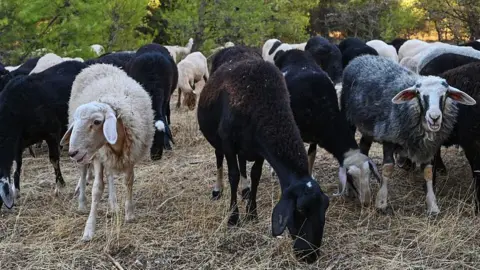
Hundreds of thousands of sheep and goats are being culled in Greece, due to the outbreak of an infectious disease. It may affect production and exports of the country's famous feta cheese.
Anastasia Siourtou walks through her deserted farm on the outskirts of Karditsa, a city in the Thessaly region of central Greece.
An eerie silence hangs over the place where 650 sheep were being raised.
On 12 November veterinary officials culled all the livestock after a case of sheep and goat pox was detected.
There is another farm two kilometres away. They had pox cases, but hid it, she says, alluding to how she believes her herd contracted the disease.
Ms Siourtou is a veterinarian herself and has expanded the farm that her father built.
Losing the animals means financial ruin - besides the livestock the farm lost, the sheep's milk, which is sold for the production of feta cheese, is often referred to as Greece's white gold.
More than the financial blow, however, Ms Siourtou speaks of the emotional toll. I was here the day the sheep were culled. It is very cruel, I felt that I failed to protect them.
Sheep and goat pox is a viral infection. The first cases were detected in northern Greece in August 2024, and the disease has since spread across many regions of the country.
A total of 1,702 incidents had been recorded by mid-November, according to the latest data from the Ministry of Rural Development and Food.
Detecting a single case on a farm means the entire herd must be culled for preventive reasons. Some 417,000 sheep and goats have been disposed of so far, which is roughly 4-5% of the previous total.
Approximately 80% of Greek sheep and goat's milk goes towards making feta cheese, which is a protected designation of origin within the European Union.
This means that while similar cheese can be produced elsewhere in the EU it cannot be called feta. The UK continues to respect this 2002 ruling following Brexit.
Last year, Greece exported €785m ($909m; £690m) of feta, figures from the Greek Exports Association show. Of this, €520m went to fellow EU nations, and €90m to the UK.
Feta has to be made of at least 70% sheep's milk, with the remainder being goat's.
Small dairies say they are already having problems sourcing sheep's milk, which could mean possible shortages of feta going forward. While prices have not yet increased in turn, this will likely be the result if the outbreak is not eradicated.
The limited amount of available milk increases production costs and makes it more difficult to maintain current quantities [of feta] on the market, says Prof Dimitris Gougoulis from the Faculty of Veterinary Medicine at the University of Thessaly.
Another sheep farmer near Karditsa, Tassos Manakas, saw his 873-strong herd culled on 9 October.
He now spends his days sitting in a small room in his barn. The shop is closed, he says bitterly.
Mr Manakas walks past the empty metal feeders and the milking room now gathering cobwebs. I used to come in in the morning, hear the animals bleating, stroke them.
The day they were culled, I was here. If you cut me that day, I wouldn't bleed.
Yet the situation now seems to be getting out of control.
Members of the National Committee for the Management and Control of Sheep and Goat Pox recently told journalists that livestock farmers in different parts of the country may have carried out as many as one million illegal vaccinations. This distorts the epidemiological picture and makes disease control even more difficult.
Farmers are upset with officials for what they say is arbitrary calculation and accuse the scientific committee of endangering the export of feta.
Despite the crisis, farmers like Haris Seskliotis are looking for new paths. I am thinking of setting up a new unit with my son for fattening calves, he says, determined to continue in agriculture despite the setbacks.