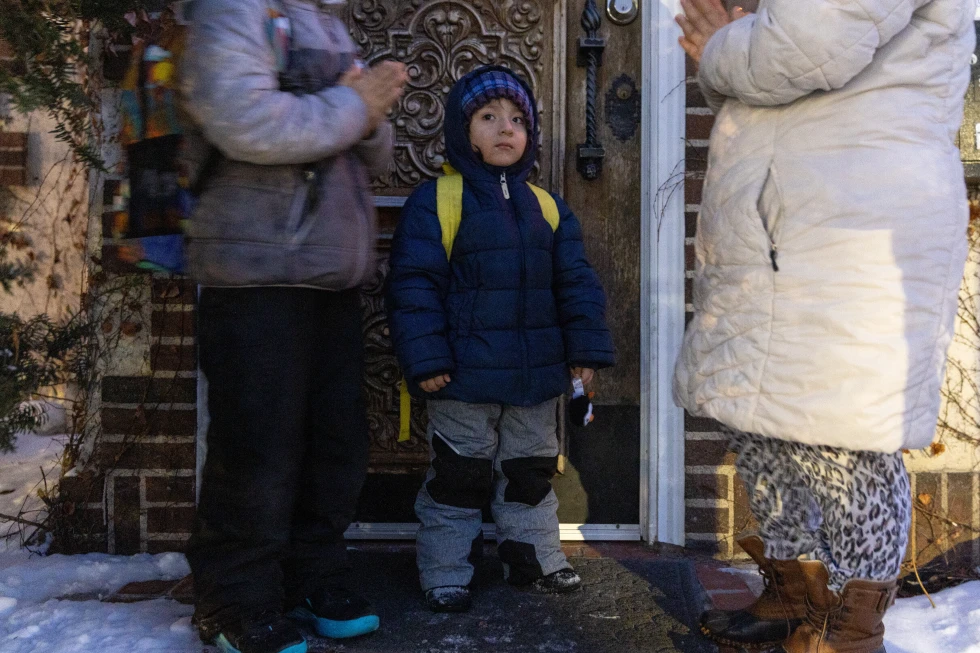
MINNEAPOLIS (AP) — In some ways, 10-year-old Giancarlo is one of the lucky ones. He still goes to school.
Each morning, he and his family bundle up and leave their Minneapolis apartment to wait for his bus. His little brother hefts on his backpack, even though he stopped going to day care weeks ago because his mom is too afraid to take him.
As they wait behind a wrought-iron fence, Giancarlo’s mother pulls the boys into the shadow of a tree to pray. It’s the only time she stops scanning the street for immigration agents.
“God, please protect my son when he’s not at home,” she says in Spanish. She spoke with The Associated Press on condition of partial anonymity for the family, because she fears being targeted by immigration authorities.
For many immigrant families in Minnesota, sending a child to school requires faith that federal immigration officers deployed around the state won’t detain them. Thousands of children are staying home, often for lack of door-to-door transportation — or simply trust.
Schools, parents and community groups have mobilized to help students get to class so they can learn, socialize and have steady access to meals. And for those who are still sending their children, the trip to and from school is one of the only risks they’re willing to take.
“I don’t feel safe with him going to school,” Giancarlo’s mother said, shaking her head. “But every day he wakes up and wants to go. He wants to be with his friends.”
Giancarlo’s Minneapolis elementary school is the best thing going for him these days. There’s soccer to play at recess. The recorder to learn. Giancarlo has set his eyes on learning the flute next year when fifth graders choose an instrument. He has “demasiado” — “too many” — best friends to name.
But his mother and brother’s home confinement weighs on him. He saves half the food he gets at school breakfast and lunch to share with them, and he’s lost four pounds this year. He takes extra care to bring pizza or hamburgers, treats the family used to eat in restaurants when his mom, an asylum-seeker from Latin America, was still working and they felt safe leaving the house. Giancarlo has also applied for asylum and his brother, Yair, has U.S. citizenship.
Sometimes only seven of Giancarlo’s classmates show up when there should be close to 30. “The teachers cry,” he said. “It’s sad.”
With as many as 3,000 federal officers roaming the state this year, some immigrant parents have made a bet that their children are safer riding or walking with white Minnesotans who were strangers just weeks ago — rather than in their own cars or while holding their hands.
“We live in a place where ICE is everywhere,” said Rene Argueta, the school’s family liaison. Argueta, himself an immigrant from El Salvador, organized the teachers walking and driving students to and from their homes.