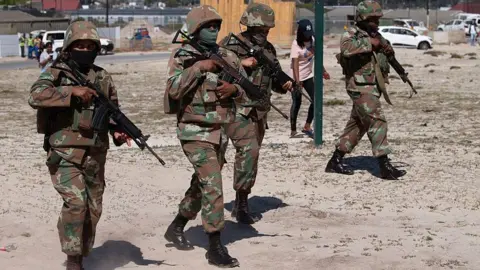
South Africa's army has officially been deployed to several parts of the country to help overwhelmed police clamp down on violent crimes, including illicit mining and gangs.
President Cyril Ramaphosa earlier this year announced the deployment of 2,200 soldiers to five of the country's nine provinces hardest hit by criminal activities.
Authorities say the deployment, set to run for a year, is aimed at restoring order to crime-ridden areas, but critics warn that using the military in civilian policing rarely delivers lasting results.
Illicit mining and gang violence are major problems in South Africa, which has one of the world's highest murder rates. According to the latest crime statistics, covering the period between October and December 2025, around 71 people were killed each day.
An initial group of soldiers was deployed to several parts of Gauteng province, which includes Johannesburg, in March. The second, and main cohort, will help with operations in the Eastern Cape, Free State, North West, and Western Cape provinces from 1 April for a year.
Residents in areas like Eldorado Park, a suburb of Johannesburg, where gang violence is prevalent, have expressed mixed feelings about the military presence. Some residents, like 74-year-old pensioner Leola Davies, described her neighborhood as a hell-hole to live in, stating she stays indoors for fear of becoming a victim.
Yet others, like Ronald Rabie, believe seeing soldiers patrol the streets does create a temporary sense of safety, though he warns that chaos returns once they leave.
The army's involvement is not new; previous deployments aimed at controlling crime and unrest have raised concerns about the military's capacity for community policing. Experts highlight that soldiers are combat-trained and might escalate tensions rather than foster trust within communities.
Critics argue that an effective solution would require addressing root causes of crime rather than relying solely on military force, which raises questions about the government's long-term strategy against escalating crime rates.
President Cyril Ramaphosa earlier this year announced the deployment of 2,200 soldiers to five of the country's nine provinces hardest hit by criminal activities.
Authorities say the deployment, set to run for a year, is aimed at restoring order to crime-ridden areas, but critics warn that using the military in civilian policing rarely delivers lasting results.
Illicit mining and gang violence are major problems in South Africa, which has one of the world's highest murder rates. According to the latest crime statistics, covering the period between October and December 2025, around 71 people were killed each day.
An initial group of soldiers was deployed to several parts of Gauteng province, which includes Johannesburg, in March. The second, and main cohort, will help with operations in the Eastern Cape, Free State, North West, and Western Cape provinces from 1 April for a year.
Residents in areas like Eldorado Park, a suburb of Johannesburg, where gang violence is prevalent, have expressed mixed feelings about the military presence. Some residents, like 74-year-old pensioner Leola Davies, described her neighborhood as a hell-hole to live in, stating she stays indoors for fear of becoming a victim.
Yet others, like Ronald Rabie, believe seeing soldiers patrol the streets does create a temporary sense of safety, though he warns that chaos returns once they leave.
The army's involvement is not new; previous deployments aimed at controlling crime and unrest have raised concerns about the military's capacity for community policing. Experts highlight that soldiers are combat-trained and might escalate tensions rather than foster trust within communities.
Critics argue that an effective solution would require addressing root causes of crime rather than relying solely on military force, which raises questions about the government's long-term strategy against escalating crime rates.