In brief
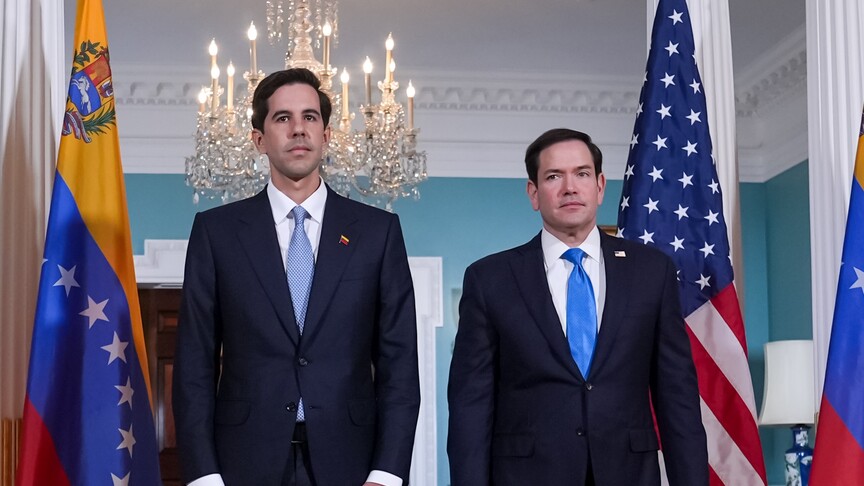
In Washington, U.S. Secretary of State Marco Rubio and Venezuelan Foreign Minister Oliver Blanco met to discuss institutional reforms and steps toward democratic elections in Venezuela, reiterating the U.S. administration’s three‑phase plan for stabilization, economic recovery, and political reconciliation. Rubio urged the release of remaining political prisoners, while both officials reviewed progress made in reconciliation talks and reforms of electoral institutions. The meeting came amid recent changes in Venezuela’s leadership structure and ongoing U.S. policy toward Caracas.
On Monday, U.S. Secretary of State Marco Rubio and Venezuelan Foreign Minister Oliver Blanco met in Washington, D.C., to discuss the future political trajectory of Venezuela and the steps needed to achieve free, fair, and credible elections, according to a State Department statement.
The State Department said the two officials reviewed the progress made by Venezuelan-led reconciliation talks, noting that institutional reforms are essential to establishing a solid foundation for elections. They highlighted the importance of a legal and regulatory framework that protects voters, ensures impartial electoral bodies, and guarantees security for all participants.
Rubio reiterated the American former president’s three‑phase plan for the country, which centres on stabilisation, economic recovery, political reconciliation, and democratic transition. The plan calls for gradual loosening of state control over key sectors, resumption of market mechanisms, and the creation of an independent electoral commission that can operate without undue influence.
Both sides underscored the role of the private sector and civil society in the transition, acknowledging that Mexico and other Latin American governments have used similar frameworks to return to democratic rule after periods of authoritarianism. The discussion also touched on the need for greater transparency in public procurement and the fighting of corruption that has plagued Venezuela for decades.
Rubio called for the continued release of political prisoners in Venezuela, a request that comes after a series of high‑profile releases—including the unfreezing of the former President Nicolas Maduro in early January. The statement warned that those still held in custody undermine the credibility of any promised future elections.
The meeting arrived at a time of significant institutional churn in Venezuela. Following an arrest of President Nicolas Maduro by U.S. forces on January 3, Vice President and Oil Minister Delcy Rodriguez was sworn in as interim president. The new administration has already introduced amendments to the national oil law and opened the door for further legal reforms that could affect how the country’s vital resources are governed.
As Washington’s diplomatic mission interacts with Venezuelan officials, the meeting highlighted the broader international push toward a negotiated settlement. The U.S. hopes that a credible roadmap to elections will lead to an outcome that reflects the will of the Venezuelan people, reducing the risk of forced or staged outcomes that have historically marred the country's electoral history.
For ordinary Venezuelans, the stakes revolve around the legality and integrity of the electoral process. A credible election means that citizens can exercise their right to vote without fear of intimidation, manipulation, or fraud. The impact of strong institutional safeguards extends beyond the ballot box, shaping how public resources are allocated, how laws are applied, and how the government measures up to international expectations for human rights and accountability.
The call to release political prisoners is particularly significant for communities that feel squeezed by a system that has historically used the judiciary to target dissent. Freeing these detainees would signal a rollback of oppressive tactics and foster an environment in which civil society can operate more freely, thereby strengthening democratic deliberation on institutions like the National Assembly and the Constitutional Court.
From a broader regional perspective, Washington’s engagement with the Venezuelan foreign ministry also reflects an ongoing concern about stability in the Western Hemisphere. The U.S. has repeatedly expressed that a managed, democratic transition is preferable to a scenario in which a single regime controls the country, as that can foster humanitarian crises and foreign investment withdrawal.
Analysts observing the meeting note that the official tone from both sides suggests a cautious optimism. While the U.S. continues to apply pressure through sanctions and diplomatic channels, the recognition of institutional reforms indicates an acknowledgment that meaningful change in Venezuela will require collaboration across political lines and a shared commitment to democratic norms.
The discussion’s emphasis on ‘free, fair and credible elections’ highlights a civic promise: that governmental legitimacy will derive from the consent of the governed rather than from power struggles and authoritarian control. Ensuring such legitimacy is central to rebuilding public trust in institutions that are crucial for safeguarding rights, providing services, and promoting economic stability.
Looking forward, little detail has been released about the specific milestones or timelines for implementing the proposed reforms. However, the State Department’s statement underscored that the U.S. will remain involved as the Venezuelan government moves forward, emphasizing accountability, transparency, and the protection of human rights as central to the transition.
As the dialogue between Washington and Caracas continues, the global community watches with interest. Whether the proposed reforms lead to an actual change in Venezuela’s electoral landscape and a restoration of human rights depends on sustained engagement, compliance from local authorities, and the resilience of civil society groups across the country.
Conclusion: The meeting between Rubio and Blanco marked a new chapter in U.S. engagement with Venezuela, focusing on institutional reforms, election integrity, and the release of political prisoners—key elements that will determine the country’s democratic future and the well‑being of its citizens.