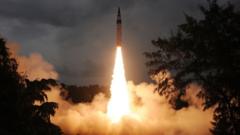
In the recent military tensions between India and Pakistan, the potential for nuclear war looms prominently yet quietly. While there was no explicit threat or ultimatum exchanged, the situation serves as a stark reminder of the region's volatility. In March 2022, an accidental missile launch by India highlighted this precariousness, suggesting that escalations could occur through human error or technological failure.
According to analysts, the risk of nuclear war, while concerning, remains relatively low as long as intense ground conflict does not erupt along the border. Both nations possess around 170 nuclear weapons each, with varying capabilities and doctrines—India operates under a no-first-use policy, while Pakistan’s approach remains ambiguous without a formal doctrine.
Past incidents, such as the Kargil War, the 2019 stand-off, and recent international interventions, have cast a shadow over both nations’ nuclear postures, revealing a complex interplay of military rivalry and deterrence. Experts claim that while neither nation is likely eager to be branded as the aggressor in a nuclear exchange, significant risks remain from miscommunication and high-stakes military posturing.
Recent developments indicate that both countries are enhancing their arsenals through advanced delivery systems and ongoing nuclear research, signaling that the conversation surrounding nuclear weapons continues to develop, albeit cautiously. The consensus among security experts is that while the deterrent holds, the persistent presence of nuclear arms in the region adds an unnerving layer of uncertainty to any dispute, rendering the peace between India and Pakistan always at risk of potential catastrophe.