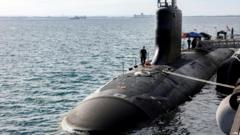
The United States has initiated a review of its multi-billion-dollar submarine agreement with Australia and the United Kingdom, citing alignment with its "America First" principles. The Aukus deal, established to enhance military collaboration and counter Chinese expansion in the Indo-Pacific, involves Australia purchasing its first nuclear-powered submarines from the US and aims to create a shared fleet utilizing advanced technology.
In light of this review, both Australia and the UK have downplayed the situation, framing it as a conventional reassessment typical of new administrations. The current scrutiny places additional emphasized demands on both allies to heighten military expenditures, with the UK set to commit 2.5% of its GDP to defense spending by 2028, and a further goal of 3%.
Founded in 2021 amidst different leaderships, the Aukus agreement is estimated at £176bn ($239bn; A$368bn). A US defense official mentioned that the review pertains to "ensuring the highest readiness of our servicemembers" and emphasizes that allies need to contribute substantially to collective defense efforts. Nonetheless, Australian Defence Minister Richard Marles expressed confidence that the pact will continue, emphasizing the nation's necessity for long-range submarine capabilities.
While some Australian officials advocate for a more self-reliant defense strategy, Marles underscored the importance of maintaining the current plan, in light of previous disputes related to the cancellation of a French submarine deal. A UK spokesperson echoed sentiment regarding the naturalness of reviews with new administrations, emphasizing the strategic significance of the Aukus pact for stability in the Indo-Pacific region.
Experts, such as Jennifer Kavanagh from Defense Priorities, support the US's decision to reassess the agreement, citing ongoing strains in its submarine capabilities. Concerns arise that Australia might not utilize purchased submarines in alignment with US interests amidst regional tensions, particularly regarding potential conflicts over Taiwan.
The review may also lead to potential shifts in the focus of the agreement, possibly favoring the exchange of long-range weapons technology over nuclear submarine provisions. A withdrawal from the agreement would likely embolden China, which has long criticized the collaboration between the three nations.
The Aukus agreement not only marks a significant enhancement of Australia’s military arsenal—making it the second nation after the UK with access to US nuclear propulsion technology—but also empowers Australia to extend its operational reach further than it could with its conventional diesel fleet. As the plan unfolds, starting 2027, both the US and UK aim to station nuclear submarines in Perth, further illustrating the strategic partnership's vital role in addressing regional security concerns.
In light of this review, both Australia and the UK have downplayed the situation, framing it as a conventional reassessment typical of new administrations. The current scrutiny places additional emphasized demands on both allies to heighten military expenditures, with the UK set to commit 2.5% of its GDP to defense spending by 2028, and a further goal of 3%.
Founded in 2021 amidst different leaderships, the Aukus agreement is estimated at £176bn ($239bn; A$368bn). A US defense official mentioned that the review pertains to "ensuring the highest readiness of our servicemembers" and emphasizes that allies need to contribute substantially to collective defense efforts. Nonetheless, Australian Defence Minister Richard Marles expressed confidence that the pact will continue, emphasizing the nation's necessity for long-range submarine capabilities.
While some Australian officials advocate for a more self-reliant defense strategy, Marles underscored the importance of maintaining the current plan, in light of previous disputes related to the cancellation of a French submarine deal. A UK spokesperson echoed sentiment regarding the naturalness of reviews with new administrations, emphasizing the strategic significance of the Aukus pact for stability in the Indo-Pacific region.
Experts, such as Jennifer Kavanagh from Defense Priorities, support the US's decision to reassess the agreement, citing ongoing strains in its submarine capabilities. Concerns arise that Australia might not utilize purchased submarines in alignment with US interests amidst regional tensions, particularly regarding potential conflicts over Taiwan.
The review may also lead to potential shifts in the focus of the agreement, possibly favoring the exchange of long-range weapons technology over nuclear submarine provisions. A withdrawal from the agreement would likely embolden China, which has long criticized the collaboration between the three nations.
The Aukus agreement not only marks a significant enhancement of Australia’s military arsenal—making it the second nation after the UK with access to US nuclear propulsion technology—but also empowers Australia to extend its operational reach further than it could with its conventional diesel fleet. As the plan unfolds, starting 2027, both the US and UK aim to station nuclear submarines in Perth, further illustrating the strategic partnership's vital role in addressing regional security concerns.