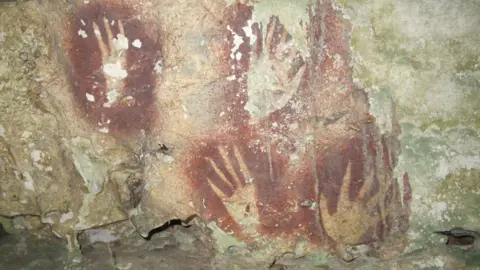
A stencilled outline of a hand found on the Indonesian island of Sulawesi is the world's oldest known cave painting, researchers say.
It shows a red outline of a hand whose fingers were reworked, creating a claw-like motif that highlights an early leap in symbolic imagination.
Researchers have dated the painting to at least 67,800 years ago, making it older than the previous record holder, a contested hand stencil in Spain by around 1,100 years.
This discovery lends credence to the view that Homo sapiens may have reached the Australia-New Guinea landmass, known as Sahul, approximately 15,000 years earlier than previously suggested.
Numerous recent discoveries on Sulawesi have shifted the paradigm that art and abstract thinking emerged abruptly in Ice Age Europe.
Cave art is crucial in marking the cognitive leap towards abstract, symbolic thinking - skills crucial for language, religion, and science. Early humans began to share stories and identities through these representations, fundamentally differentiating them from other species.
Professor Adam Brumm of Griffith University, who co-led the research, asserts that this painting emphasizes that creativity was an inherent part of our species long before what was traditionally viewed as a 'creative explosion' in Europe. When I went to university in the mid-90s, we were taught that this creative burst happened in a small part of Europe, but current evidence, like narrative art in Indonesia, is challenging that Eurocentric narrative, he explained.
The previously known oldest cave art in Spain dates back to at least 66,700 years, but its dating remains contentious.
In a series of breakthroughs, hand stencils and animal depictions from Sulawesi, dating over 40,000 years, have previously been discovered, contributing to the growing body of evidence pushing these dates further back. The recently discovered painting comes from a limestone cave named Liang Metanduno, showcasing an artistry technique involving spraying or spitting pigment around a hand pressed against the cave wall, creating a negative outline.
The significant age of 67,800 years for the art challenges long-held assumptions and supports growing evidence of early human creativity across different regions, including Africa.
These implications stretch to assess when the ancestors of Aboriginal Australians first arrived on Sahul, suggesting a much earlier presence than previously believed.
In light of this, there is a new consensus forming among archaeologists regarding a broader, deeper story of human creativity, which likely existed long before humans left Africa. This revelation transforms our understanding of when and where symbolic behavior originated in the human timeline.