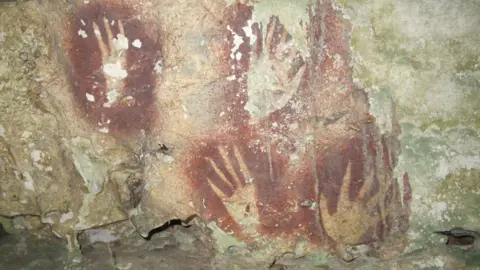
NEW YORK (AP) — Handprints on cave walls in a largely unexplored area of Indonesia may be the oldest rock art studied so far, dating back to at least 67,800 years ago. The tan-colored prints analyzed by Indonesian and Australian researchers on the island of Sulawesi were made by blowing pigment over hands placed against the cave walls, leaving an outline. Some of the fingertips were also tweaked to look more pointed. This prehistoric art form suggests the Indonesian island was home to a flourishing artistic culture. To figure out how old the paintings were, researchers dated mineral crusts that had formed on top of the art. Upon seeing the new study, independent paleoanthropologist Genevieve von Petzinger expressed her excitement, saying it aligns perfectly with her hypotheses. Indonesia is known for housing some of the world's earliest cave drawings, and while countless examples of ancient art have been analyzed globally, including marks that date back hundreds of thousands of years, the new findings highlight that the art tradition in southeastern Sulawesi represents a complex and shared cultural practice. Maxime Aubert from Griffith University notes that this discovery opens the door to further inquiries into the artistic traditions shared across different regions. Scientists are eager to understand the progression of art, moving from simple designs to more expressive representations. It’s not yet clear whose hands made the prints; they could be from ancient Denisovans in the region or modern humans migrating out of Africa. Other more recent artworks in the same area, including various animal figures, date back only about 4,000 years. Despite the uncertainties, the findings suggest there may be more art yet to be discovered, potentially even older than these handprints. Aubert stated, 'For us, this discovery is not the end of the story, it is an invitation to keep looking.'
Oldest Handprints in Cave Art Discovered in Indonesia

Oldest Handprints in Cave Art Discovered in Indonesia
Recent archaeological findings reveal handprints dating back over 67,800 years, potentially redefining our understanding of early human creativity.
Researchers have discovered ancient handprints on the cave walls of Sulawesi, Indonesia, which are believed to be over 67,800 years old, making them the oldest known rock art. This discovery sheds new light on the early development of artistic expression among humans and opens the door to understanding the cultural practices of our prehistoric ancestors.