In brief
In Central Kalimantan’s Palangkaraya, smoldering peat fires have released toxic haze that lingers over parts of Southeast Asia. Residents, especially children, struggle to breathe while the government deploys water‑bombing operations and crowd‑sourced aid. Health officials report rising respiratory cases, and local citizens debate the feasibility of staying indoors. The crisis illustrates the widening impact of climate change on ordinary lives.
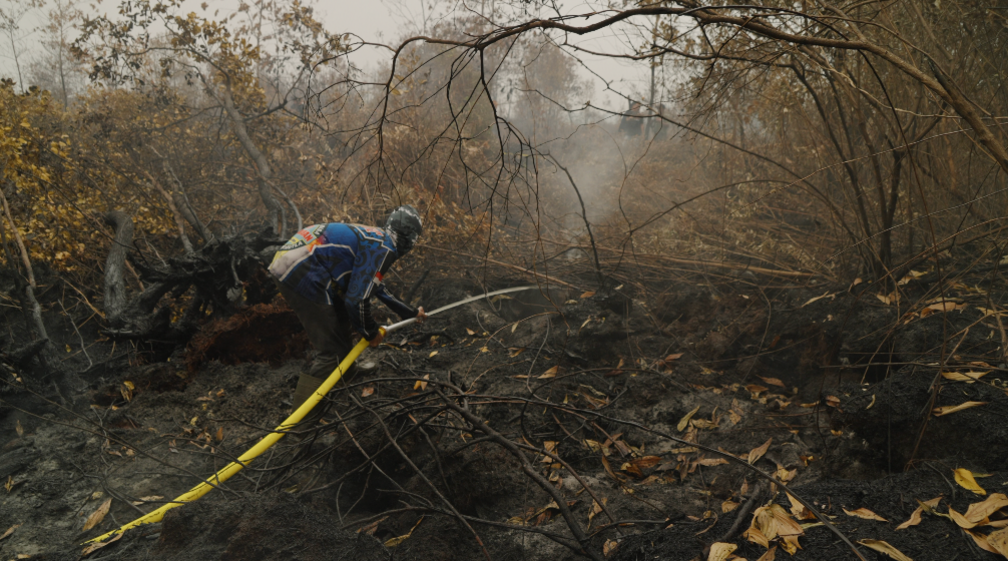
Central Kalimantan’s capital, Palangkaraya, is shrouded in a yellow‑thick haze that turns the morning sun into a rust‑orange smear. The culprit? A relentless series of peatland wildfires that have scorched roughly 1.9 million hectares in 2026, a burn area that would fit three. These fires, intensified by a severe drought set by a super El Nino, release smoke laden with microscopic sulphur, nitrogen, and carbon‑based particles that seep deep into lungs and bloodstream.
For Dianyra Eka Nastiti, a mother of three from Palangkaraya, the haze is more than a visual nuisance. She has watched her youngest child contract bronchopneumonia, and every night she mutters, “Will she cough tomorrow?” The fear is shared by many. Hospital records from Indonesia’s Health Ministry show over 277,000 cases of chronic cough and acute respiratory infection across the country, with 62,000 of those below five years old.
Local health officers warn that the “carbon‑laden air” strips the oxygen that lungs need and can push individuals toward long‑term lung damage or premature death. Children, pregnant women, and the elderly are flagged as most vulnerable. In response, authorities have pledged to battle the fires with a “land operation” that deployed more than 60,000 personnel and aims for an 80 % extinguishment success rate, but the deep, water‑hungry peat layers make full suppression challenging.
While the government pours resources into firefighting, ordinary residents face a paradox: it is impossible to go out for basic errands and yet the smoke makes staying indoors dangerous. “We still have to buy food, attend school, and run daily work,” says Dianyra, practicing house‑bound measures to protect her children. Many have shifted to online schooling and are outsourcing key errands, but the economic toll is swift.
The haze’s reach extends beyond Indonesia’s borders; it drifts over Singapore, Malaysia, and the Philippines, prompting multi‑country concern. Across the region, scientists monitor the transition from gas‑to‑particle emissions, noting how the particulate matter continues burning underground, extending the smog’s lifespan. The community’s hope has turned toward heavy rains, but with water scarcity mounting, the future remains uncertain.
The crisis underlines the urgency of protecting peatlands, a vital carbon sink, and illustrates how the rare “carbon bombs” created by burned peat are a fatal consequence of unsustainable land management. Until the fires are contained and policies change, residents of Borneo will continue to live with air that feels as heavy as the ground beneath their feet.