Spain's Roman Catholic Church has reached an agreement with the government to compensate victims of sexual abuse by members of the clergy.
The accord follows complaints that religious leaders had failed to tackle the issue adequately.
It means the government will manage possible compensation in co-ordination with the Church, handling cases where other legal avenues are no longer available because the alleged crime took place too long ago or the individual accused has passed away.
Hundreds of thousands of Spaniards are estimated by the government to have suffered sexual abuse at the hands of Church figures. The move follows similar redress schemes in other nations where abuse has been uncovered.
A democracy should not allow the existence of victims who have never been compensated [and] whose situation, on the contrary, had been covered up, said Justice Minister Félix Bolaños after signing the agreement.
He added that the agreement sought to pay off an historic, moral debt that we had with victims of abuse within the Church.
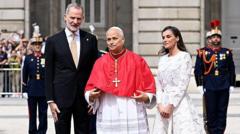
The other signatories were Luis Argüello, president of the Episcopal Conference and leader of the Spanish Catholic Church, and Jesús Díaz Sariego, president of Confer, which represents Catholic congregations and religious orders.
Mr Sariego said the initiative was unprecedented as it tackled crimes that had gone past the statute of limitations.
Argüello, who is archbishop of Valladolid, described the accord as another step forward along the path that for years we have been travelling.
A 2023 study by the Spanish ombudsman's office, which investigates public complaints, estimated that 1.1% of the population had suffered sexual abuse at the hands of members of the clergy or individuals linked to the Church - the equivalent of 440,000 people.
The Church has contested these findings.
It set up a reparation scheme that year to manage abuse claims.
However, both the Socialist-led government and victims' organisations have been dissatisfied with the scheme's model, which did not allow input or oversight from outside the Church.
In November, the Church said that 58 cases had been resolved under its framework.
However, critics accused the institution of a lack of transparency and slowness.
The new system allows victims to file their cases before a new agency created by the justice ministry, which will then take them before the ombudsman's office to draw up a reparation proposal.
The Church must then agree to the proposed compensation; if not, the case will be referred back to the ombudsman.
Reparation can be symbolic, psychological, or economic, according to the agreement. However, the specific amounts of financial compensation have not been determined.
Critics, including victims' groups, have welcomed the new agreement, asserting that it addresses systemic issues within the Church regarding accountability and transparency.