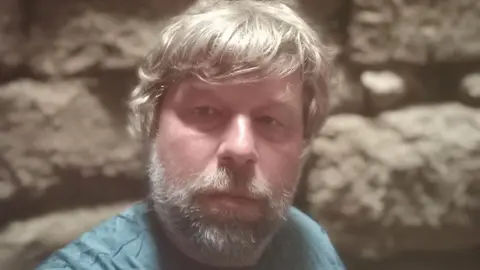
A Russian archaeologist detained in Poland is at the centre of an intense debate over the role of museums and experts and the role they play in Kremlin war propaganda.
Alexander Butyagin is under arrest in Warsaw, awaiting a Polish court decision on a request to extradite him to Ukraine. Until now, courts across Europe have been reluctant to extradite Russians to Ukraine, citing the European Convention on Human Rights.
Butyagin's case has divided opinion. A senior scholar at the Hermitage, Russia's largest art museum in St Petersburg, he has led the museum's expedition at the site of Myrmekion in Crimea since 1999, well before Russia's illegal landgrab of Ukraine's southern peninsula in 2014. Supporters argue his work has helped preserve Crimea's ancient heritage, but critics say he is no better than a looter of Ukrainian history making the most of Russia's occupation.
Myrmekion dates back to the 6th Century BC, when the Ancient Greeks settled in Crimea as democracy was being born in Athens. Butyagin's expedition has uncovered hundreds of ancient coins at the site, some from Alexander the Great's period in the 4th Century BC.
His expedition continued after Russia seized Crimea from Ukraine, and a criminal case was opened against him by Ukrainian authorities for working there without authorisation. In November 2024, he was placed on a wanted list, and in April 2025 a Kyiv court ordered his arrest in absentia. Butyagin is accused of illegal excavations and illegal partial destruction of an archaeological complex.
Under the 2nd Protocol to the Hague Convention for the protection of cultural property in the event of armed conflict, occupying authorities shall prohibit and prevent any archaeological excavations with only a few exceptions. Both Poland and Ukraine are parties to the protocol, while Russia is not.
Excavations, however ethical, amount to destruction if they take place without permission and under conditions of armed conflict, says Evelina Kravchenko, a senior researcher at the Institute of Archaeology of the National Academy of Sciences of Ukraine.
Butyagin violated the Hague Convention, and all his problems stem from that, says Krachenko, whose committee issued permits for Russian archaeologists to work in Crimea before its annexation. Butyagin told Russian media last year he was simply doing the work we've devoted our lives to, and that his main goal was preserving monuments.
The Hermitage press office insisted Butyagin's work complied with all international legal and ethical norms regardless of geopolitical circumstances. A senior archaeologist from the museum told the BBC that Butyagin had followed the only path available for Russian archaeologists working in Crimea.
Several Ukrainian sources have also accused Butyagin of looting objects by taking them to Russia, although these charges are not part of Ukraine's case. Both the archaeologist and the Hermitage insist all their finds remain in Crimea as they are transferred to the Eastern Crimean Museum in Kerch.
Since the start of the war, several European courts have refused Ukraine's requests to extradite Russians, citing potential risks under the European Convention, which prohibits politically motivated persecution and violations of the right to a fair trial. Even if the Polish court deciding Butyagin's case does find sufficient grounds to extradite him, it might not go ahead, says Gleb Bogush, a researcher at the Institute for International Peace and Security Law at the University of Cologne.
Butyagin has attracted support not just from the Kremlin but from Russians who oppose Putin and the war. The claims being made against him are absurd, said Arseny Vesnin, an exiled journalist and historian. Others maintain that artefacts would have been looted by criminals and sold on the black market if Russian archaeologists had refused to work in Crimea.
While this line of argument suggests that continued excavation helps preserve heritage, it does not absolve Byutagin or his colleagues of the ethical implications of working in a conflict zone, as highlighted by experts in cultural preservation.