In brief
Prime Minister Benjamin Netanyahu has signaled a bold strategy to expand Israeli settlements, focusing on the East‑1 (E1) zone east of Jerusalem. The move has drawn sharp condemnation from the United Nations, European countries, and the Palestinian Authority, who warned it could block the creation of a contiguous Palestinian state. Parallel to the settlement expansion, Israel has increased road construction and civil administration within the West Bank, further entrenching Israeli presence and embarring Palestinian communities. Violence against Palestinians has escalated, with incidents such as the siege of homes sparking international criticism. With elections looming, the settlement push appears aimed at consolidating political gains while reshaping the region’s geography.
Prime Minister Benjamin Netanyahu declared he would fulfil a promise that no Palestinian state would be formed, saying "This place belongs to us," during a ceremony at a West Bank settlement last September. He signed an agreement to push forward with the expansion of a settlement in the East‑1 (E1) area, just east of Jerusalem.
Following the announcement, the Israeli government opened tenders for the construction of around 1,200 settlement homes, prompting widespread condemnation. All settlements are illegal under international law, and under global pressure Israel had held off on building in the area for decades.
The United Nations said the plan posed an "existential threat" to a future Palestinian state, while a joint statement by Britain, France, Germany, Italy and Canada labelled the plans "unacceptable" and warned they would "drive a wedge through the West Bank," a view echoed by the European Union.
The Palestinian Authority’s president Mahmoud Abbas called for the signatories to take "concrete measures to halt the implementation of the E1 plan". In 2026, Israel has built about 160 settlements housing 700,000 Jews since 1967.
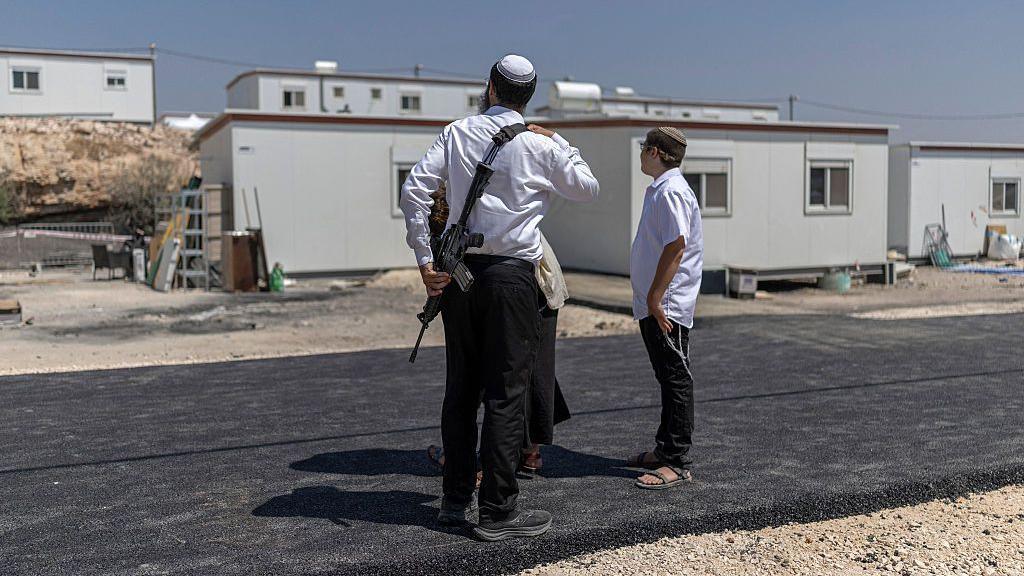
The speed of settlement construction has increased since 2022, especially after Netanyahu’s return to power ahead of the Gaza war triggered by Hamas’s 7 October attack. For example, BBC Verify analysis shows 185 new buildings in the northwest settlement of Tzofim since 2022.
Road construction has also accelerated, with the government earmarking more than a billion shekels ($360m) for new roads in the West Bank. This infrastructure not only connects settlements but bisects Palestinian towns, strengthening Israel’s hold on the territory.
Settler violence has worsened, exemplified by a recent siege where Palestinian homes were cut off from water and power. US Ambassador Mike Huckabee denounced the attack as a "criminal and terrorist act". These developments feed fears that the "facts on the ground" make a Palestinian state unviable.
Minister Bezalel Smotrich argued in 2024 that the E1 construction would help "establish sovereignty in Judea and Samaria"—a name Israel uses for the West Bank—"first on the ground and then through legislation," claiming his life’s mission is to thwart a Palestinian state.
With Israeli elections approaching, the settlement push may serve to consolidate political power. Whether the moves achieve electoral success or cement a new status quo, they underscore Israel’s commitment to reshape the West Bank’s geography.