In brief
Typhoon Champi has caused massive disruptions in Taiwan and surrounding regions, with hundreds of flights cancelled and schools and offices closed. One person died and 171 were injured, and at least 1,000 were evacuated. The storm, a Category‑5 super typhoon amplified by a strong El Niño, threatened up to 90 cm of rain and winds over 190 km/h. While its eye is expected to miss Taiwan, officials warn it could stall or make landfall, prompting nationwide safety measures.
Hundreds of flights in the East Asia region were cancelled on Friday as powerful Typhoon Champi roared close to Taiwan's north‑east coast.
Schools and offices across Taiwan were shut as the storm approached, and authorities warned that weather could still force a landfall. The forecast called for 90 cm of rain and strong winds to move through the northern eastern region until Saturday.
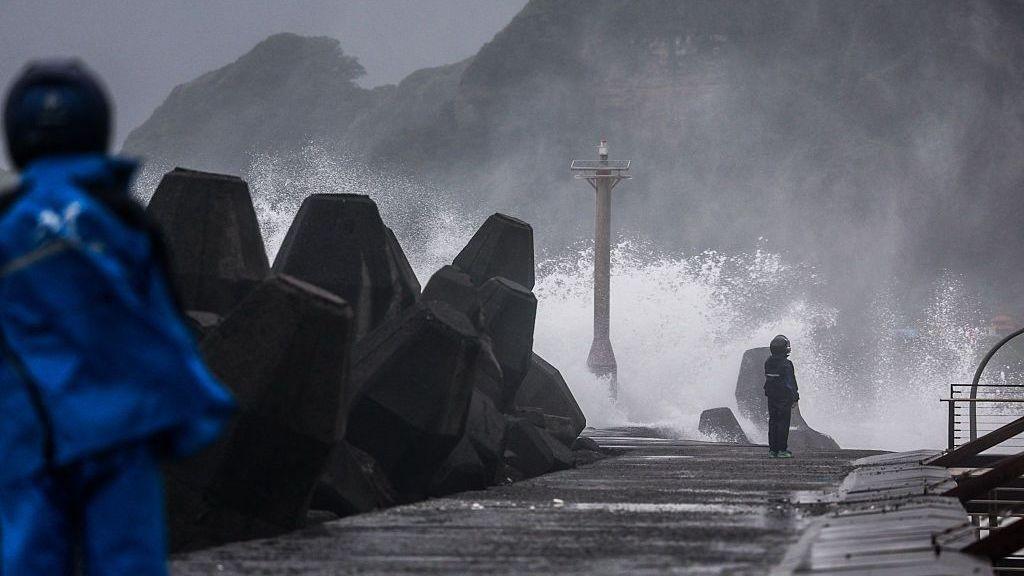
One person died after being swept away by waves, authorities said. The storm also injured 171 people and forced 1,000 others to evacuate.
Champi is the latest in a string of intense typhoons as a Super El Niño heats the Pacific Ocean and fuels storms, and at its peak earlier this week it was the planet's strongest storm of the year so far.
On Friday afternoon, Champi was packing wind gusts of 191 km/h (119 mph).
After passing Taiwan's north‑eastern tip and the Okinawa islands in southern Japan, the typhoon is expected to hover over waters off China's eastern coast before curving farther north‑east toward Japan's main island.
Weather agencies in Taiwan, Hong Kong and Japan forecast that the eye of the storm is expected to pass without making landfall in Taiwan, but a forecaster in Taiwan's Central Weather Administration said that a landfall could not be ruled out completely if the storm stalls, loops or wobbles from side to side as it approaches.
Rainfall is expected to peak on Saturday morning and continue to batter Taiwan until Saturday evening, the Central Weather Administration said.
Taiwanese authorities have urged people to stay away from coasts and mountains.
Work and classes were suspended in nearly all of Taiwan's 22 counties and cities on Friday – a "typhoon holiday" – as Champi approached the island. Taiwan's $5tn stock exchange was also closed that day because of the severe weather.
Only Kinmen county, an archipelago located to the west of Taiwan's main island, continued work and classes as usual.
In Japan, power cuts were reported in nearly 8,400 households in the southern Okinawa prefecture, according to the local power company. More than 160 flights have been cancelled across four Japanese airlines.
Champi also stirred heavy rains and winds in Batanes, a Philippine island chain below southern Taiwan, with waves crashing into seaside villages and roads closed to traffic. No immediate reports of casualties were noted.
Typhoon Champi became the strongest storm of the year earlier this week, when it attained a maximum sustained wind speed of 185 mph (298 km/h) as it moved over the Philippine Sea – the equivalent of a Category 5 hurricane. While initially ranked as a "super typhoon", Champi weakened on Wednesday as it continued barrelling across the sea.
This activity is shaping up to be one of the most active typhoon seasons the region has seen in years, with Champi Japan's 30th typhoon of the year – the first time since 2013 that the country has seen so many storms.
The recent frequency of storms is due to an unusually strong El Niño, a naturally occurring phenomenon that hits the Pacific Ocean every few years and can trigger extreme weather events, from droughts to typhoons.