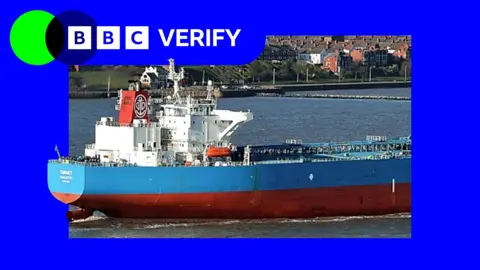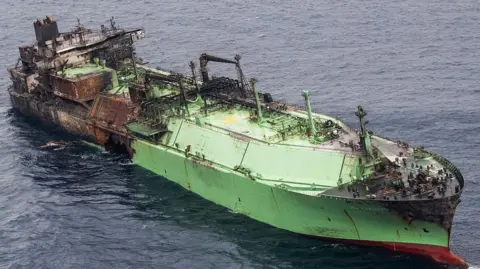
A sanctioned Russian tanker loaded with liquid natural gas is drifting out of control in the Mediterranean with no crew on board and a gaping hole in one side, prompting warnings of a serious risk of a major ecological disaster.
An official in Italy, one of nine EU countries to write a joint letter to the European Commission urging action, has called the Arctic Metagaz an environmental bomb waiting to go off.
The tanker, part of a shadow fleet transporting sanctioned Russian oil and gas, was badly damaged in a suspected sea drone attack near Maltese waters earlier this month.
Ukraine has not commented on reports that it was responsible for crippling it.
The Arctic Metagaz is now floating south away from Italian waters and the island of Lampedusa towards Libya, with Italian and Maltese officials continuing to monitor its movement.
Speaking on Italy's Radio 24, the secretary of Italy's Council of Ministers, Alfredo Mantovano, said the risks from the tanker were enormous and warned that it could explode at any moment.
It is said to be carrying significant quantities of liquid natural gas, or LNG. An official in Rome told the BBC it also had 450 tonnes of fuel oil and 250 tonnes of diesel on board.
On Tuesday afternoon the tanker was about 45 nautical miles (83km) from Italian territorial waters and 25 miles from the search-and-rescue zone ascribed to Libya.
The Arctic Metagaz set out from the Russian port of Murmansk in February.
In early March, when it went up in flames, Russian President Vladimir Putin blamed Ukraine for a terrorist attack.
But Ukraine sees such shadow Russian tankers as legitimate targets: they routinely sail with their transponders turned off to evade Western sanctions and the money Moscow makes from the oil and gas helps fund its ongoing war on Ukraine.
Recently, the number and scope of drone strikes on Russian tankers has been increasing.
It was said to be empty at the time.
It is now two weeks since the Arctic Metagaz was badly damaged by a series of explosions and fire. The crew were located and rescued by the Libyan coastguard.
Libyan port officials said initially that the tanker had sunk, but it has been floating, unmanned and dangerous ever since.
The World Wildlife Fund has said it is on maximum alert, warning that a potential spill could cause fires and long-lasting pollution in an area of exceptional ecological value that is home to numerous protected species.