In brief
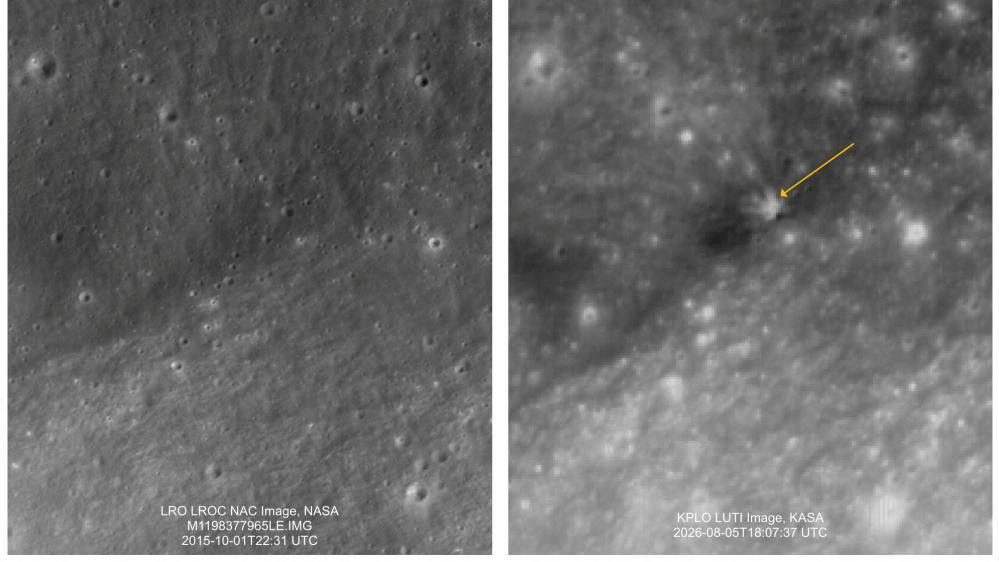
The Korean AeroSpace Administration (KASA) released satellite footage capturing the Moon’s surface before and after the accidental impact of a spent Falcon 9 upper stage from a SpaceX launch. The debris struck the lunar surface at 06:35 GMT on Wednesday, an event it says was unintentional. While the impact poses no danger to Earth, astronomers warn that the growing volume of space debris could make future missions increasingly hazardous. The incident underscores the need for better debris monitoring and international cooperation in managing the crowded space environment.
The Korean AeroSpace Administration (KASA) has released images that show the Moon before and after part of a SpaceX Falcon 9 rocket accidentally landed on its surface on Wednesday.
KASA said the Danubri lunar orbiter collected images at 06:35 GMT, providing a clear before‑and‑after comparison. SpaceX confirmed that the collision was not intentional.
The impacted portion was the upper stage of a Falcon 9 rocket that was launched in January 2025 to send a Firefly Aerospace lunar lander into lunar orbit. The stage is roughly the size of a five‑storey building and weighs about 4,000 kg on Earth. It drifted in a looping orbit that gradually accelerated under lunar and solar gravity, ultimately striking the Moon.
While the impact poses no danger to Earth, it highlights growing concerns about space debris. Astronomer Matt Bothwell of the University of Cambridge warned that an increasingly crowded environment could soon make it difficult to navigate past Earth’s orbit. Bothwell said, “Space is getting more and more crowded, and in a few decades we could find it hard to get past Earth's orbit because there’s so much junk.”
KASA displayed images from its Danubri orbiter to aid specialists in assessing the damage and potential impacts on future missions. The incident also underscores the importance of international cooperation in tracking and mitigating space debris.
For readers interested in deeper details about the incident and its implications, KASA is continuing to share updated imagery and data as it proceeds with analysis.