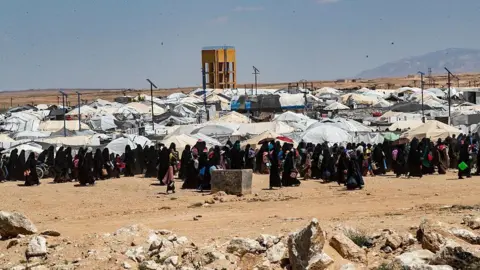
Syria's government has announced a new ceasefire with the Kurdish-led Syrian Democratic Forces (SDF), after the militia alliance withdrew from a camp holding thousands of people with alleged links to the jihadist group Islamic State (IS).
The SDF said its forces were compelled to leave Al-Hol camp and redeploy to other cities in north-east Syria due to the international indifference toward the issue of [IS].
Syria's interior ministry complained that the withdrawal took place without coordination with the government or the US-led coalition against IS.
Later, the presidency said it had reached an understanding with the SDF regarding the future of Hassakeh province, which has a large Kurdish population.
A statement specified that the SDF would have four days to consult on a detailed plan for the peaceful integration of its controlled areas into the state. Additionally, the presidency assured that government forces would not enter the cities of Hassakeh and Qamishli, or any Kurdish villages.
In return, the SDF declared its commitment to the ceasefire, stating its forces would refrain from initiating any military action unless attacked, and expressed readiness to implement the recently negotiated deal meant to end a nearly two-week confrontation.
The accord is expected to see the Kurdish-run autonomous region come under government control while allowing the integration of tens of thousands of SDF fighters into national defense and interior ministries. This represents a significant setback for the SDF, which had been reluctant to relinquish the autonomy it gained in fighting against IS during Syria's lengthy civil war.
Interim President Ahmed al-Sharaa, who led the offensive that ousted Bashar al-Assad late last year, has expressed intentions to reunify a divided Syria, which continues to experience violent sectarian tensions.
Prior to the recent withdrawal, the SDF held approximately 8,000 suspected IS fighters in prisons, while the UN reported around 34,000 people linked to IS were detained in camps, predominantly made up of women and children.
The SDF’s decision to leave Al-Hol was driven by mounting pressure and the deteriorating security landscape, amidst accusations of uncoordinated military advances by Syrian government forces.
The international community has faced criticism for its perceived failure to address the deteriorating conditions in these detention facilities, as the call for repatriation of foreign IS members and their families remains largely unanswered.