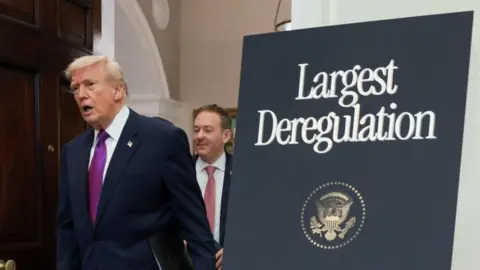
President Trump's favourite word is tariffs. He reminded the world of that in his pre-Christmas address to the nation.
With the world still unwrapping the tariffs gift from the first year of his second term in office, he said they were bringing jobs, higher wages, and economic growth to the US.
That is hotly contested. What is less debatable is that they've refashioned the global economy and will continue to do so into 2026.
The International Monetary Fund (IMF) says that although the tariff shock is smaller than originally announced, it is a key reason why it now expects the rate of global economic growth to slow to 3.1% in 2026, a slight change from a previous forecast of 3.3%.
For Kristalina Georgieva, head of the IMF, the outlook is better than we feared, worse than it needs to be. She explains that growth has fallen from a pre-Covid average of 3.7%, and this slow growth isn't sufficient to meet global aspirations for improved living standards.
Other forecasts for 2026 are even more pessimistic than the IMF's predictions, and Maurice Obstfeld from the Peterson Institute for International Economics notes that the tariffs implemented have not escalated into a dire situation primarily because countries didn’t retaliate strongly against the US.
Despite the frictions induced by tariffs, they have increased costs for many businesses and led to greater uncertainty across markets. This climate complicates future planning and investment.
Lower interest rates, a decline in the dollar’s value, and various exemptions within the tariff structure have somewhat mitigated the adverse effects. The UN trade agency UNCTAD even notes a 7% growth in global trade, reaching over $35 trillion last year.
Economists highlight that while the US economy saw a growth of 4.3% in the last quarter of 2025, leading analysts believe we haven't fully realized the tariffs' long-term impacts on inflation—currently at 2.7%—which significantly influences consumer behavior.
As 2026 unfolds, further international discussions regarding the renegotiation of trade agreements like the US Mexico Canada Agreement (USMCA), coupled with the looming Supreme Court decisions on tariffs, will undoubtedly shape the global economic landscape.
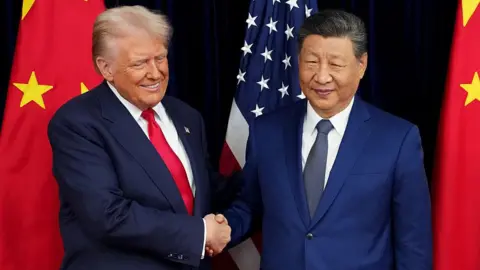
Key trade relationships, especially U.S.-China ties, remain closely scrutinized, and ongoing negotiations look to address wide-ranging issues including tariffs, rare earth metals, and manufacturing practices as the two nations navigate their economic interactions.
The complexities and uncertainties surrounding tariffs will persist, warranting continued observation and analysis as we move forward.