Spanish Prime Minister Pedro Sanchez has promised to get to the bottom of why two high-speed trains collided in southern Spain killing at least 40 people, as rescuers continue to search the wreckage.
After visiting the site of the crash, Sanchez also announced three days of national mourning for victims.
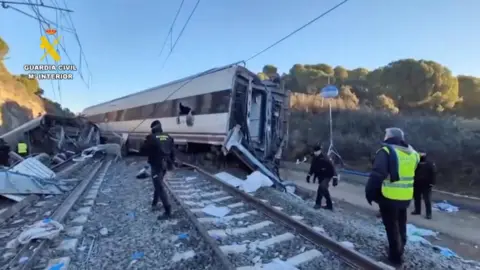
More than 120 more people were injured as carriages on a Madrid-bound train derailed and crossed over to the opposite tracks, colliding with an oncoming train in Adamuz on Sunday evening.
The crash is the worst the country has seen in more than a decade.
Rail network operator Adif said the collision happened at 19:45 local time (18:45 GMT) on Sunday, about an hour after one of the trains left Málaga heading north to Madrid, derailing on a straight stretch of track near the city of Córdoba.
The force of the crash pushed the carriages of the second train into an embankment, according to Transport Minister Óscar Puente. Most of those killed and injured were in the front carriages of the second train, which was travelling south from Madrid to Huelva.
Rescue teams reported that the twisted wreckage of the trains made it difficult to recover people trapped inside the carriages.
Sanchez visited the site of the crash with senior officials, stating, This is a day of sorrow for all of Spain, for our entire country. We are going to get to the truth; when that answer about the origin and cause of this tragedy is known, we will make it public with absolute transparency and clarity.
Puente noted that an investigation could take at least a month, describing the incident as extremely strange.
Some reports suggest a faulty joint on the rails may have caused the crash by widening a gap between rail sections as trains passed over it. However, it remains unclear if this fault was a result of the crash or a cause.
Four hundred passengers and staff were on board the two trains, and emergency services treated 122 individuals, with 41 still hospitalized, 12 of whom are in intensive care. The death toll could rise as officials work to identify the deceased.
The type of train involved, a Freccia 1000, can reach speeds of 400 km/h (250 mph).
Survivors described the impact as feeling like an earthquake, with harrowing footage showing the wreckage and emergency rescue efforts underway. All high-speed services between Madrid and the southern cities have been suspended until further notice.
The Spanish Red Cross has deployed support services to assist those affected while families await news of their loved ones. This disaster echoes the tragedies of past rail incidents in Spain, including the 2013 derailment in Galicia, which resulted in the deaths of 80 people.