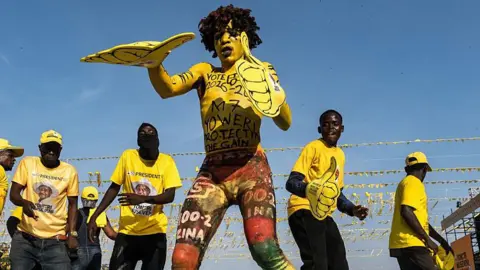
For supporters of Uganda's President Yoweri Museveni, his resounding victory in the just-concluded election is a vindication of his 40-year-long rule.
He won with 72% of the vote, close to his highest-ever tally of 74% in Uganda's first direct presidential election in 1996. This reinforces the 81-year-old's claim that he still commands the support of the overwhelming majority of Ugandans, after seizing power as a rebel commander in 1986, ending the rule of the Milton Obote regime.
However, Museveni's main election rival - former pop star Bobi Wine - dismissed the result as fake, claiming he has gone into hiding following a raid on his home by security forces.
Museveni campaigned on his track record, arguing that he has delivered political and economic stability amid global uncertainty. He pledged to steer Uganda towards achieving middle-income country status by 2030, a milestone framed as a legacy for his seventh - possibly final - term.
Key to this ambition is Uganda's emerging oil industry, with Museveni promising double-digit economic growth once exports commence later this year.
Despite his advanced age, the president has sought to project vitality. Yet, the abrupt cancellation of several campaign events raised speculation about his health and suitability for leadership.
Bobi Wine, with roots in Uganda's youthful demographic, suffered a blow as his vote share dropped from 35% in 2021 to 25% this election. He claims the election lacked credibility due to security forces disrupting his rallies and intimidation tactics against supporters.
Many analysts now question the future of opposition politics in Uganda, with fears that figures like Wine could be sidelined permanently by increasing repression.
As commentary turns to Museveni's succession, the significant role of his son, Gen Muhoozi Kainerugaba, is becoming more evident, especially amidst signs of a power shift within the ruling National Resistance Movement (NRM).
Experts suggest political change in Uganda is gradual, cautioning that the next chapter in its governance will be shaped by internal dynamics within the NRM rather than sudden revolutionary shifts.