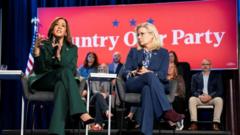
Kamala Harris embarked on a pivotal campaign initiative on Monday, engaging independent and Republican voters in the Democratic Party’s key battleground states of Pennsylvania, Michigan, and Wisconsin. Just weeks before the election, Harris partnered with Liz Cheney, a prominent anti-Trump Republican, for a town hall-style tour aimed at disaffected voters seeking alternatives to the current Republican leadership.
Choosing a dialogue-based format, Harris and Cheney were joined by notable figures, including Republican pollster Sarah Longwell in Pennsylvania and conservative commentator Charlie Sykes in Wisconsin, as well as Maria Shriver in Michigan. The selected suburban areas surrounding major cities were strategic, targeting college-educated voters who have shown signs of shifting toward the Democratic Party in recent elections.
Craig Snyder, a Republican strategist supporting Harris, emphasized the importance of Republicans reaching out to other Republicans for persuasion. Cheney echoed this sentiment, reassuring voters that their choices reflect their values, stating, “You can vote [with] your conscience and not ever have to say a word to anybody.”
Throughout their tour, various topics were addressed, including education, healthcare, and foreign policy concerns, in a manner that allowed Harris to reinforce her campaign messages. Audience members, comprised mainly of friendly participants, posed pre-selected questions that highlighted crucial Democratic priorities such as healthcare and reproductive rights.
In stark contrast to Trump’s isolationist foreign policy, both Harris and Cheney expressed concerns over potential geopolitical repercussions, emphasizing the need for robust support for Ukraine. As the town hall meetings unfolded, attention shifted to the contentious issue of abortion, which allowed Cheney to convey the message that restrictions imposed by Republican states were excessive.
Current polling indicates a tight presidential race in the battleground states, an area that had shifted to Trump in 2016 but was reclaimed by Joe Biden in 2020. As less than 10% of Republicans currently support the Democrats, the Harris-Cheney initiative might effectively leverage the coalition of voters seeking principled leadership over party loyalty.
Ultimately, Harris’s collaboration with Cheney signifies a targeted outreach approach to bridge the divide and potentially sway key voters ahead of the election, making a lasting impact in a landscape dramatically altered by Trump’s legacy.