US Defence Secretary Pete Hegseth has said he did not personally see survivors before a deadly follow-up strike on an alleged drug boat in the Caribbean.
An initial strike reportedly left two survivors clinging to the burning vessel, before a second strike was allegedly ordered that left them dead.
The 2 September strike has prompted concerns that US forces may have violated laws governing armed conflict.
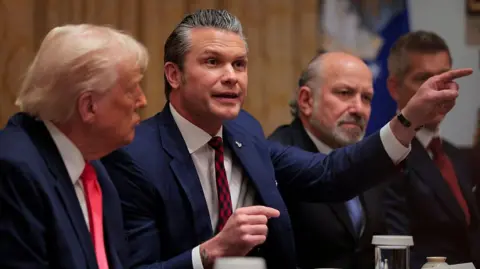
During a cabinet meeting at the White House, Hegseth attributed the strike to the fog of war in a chaotic situation. The White House has said that a top US Navy admiral, Frank Bradley, authorised the second strike.
The Washington Post first reported details about the second strike, which has led to concern from both Democratic and Republican lawmakers.
In response to a reporter's question during a cabinet meeting on Tuesday, Hegseth said that he watched the first strike live but quickly moved on to another meeting.
I did not personally see survivors, Hegseth said of the first strike. That thing was on fire and it exploded... you can't see anything. This is called the fog of war.
He added that he learned of Admiral Bradley's correct decision to sink the boat a couple of hours later.
We have his back, Hegseth said of Bradley.
President Trump also defended Adm Bradley but distanced himself from the decision for the second strike, stating that we didn't know about it.
More than 80 people have been killed in a wave of similar strikes across the Caribbean and Eastern Pacific since early September.
The Trump administration has defended the strikes as necessary self-defence measures against illicit drug activities.
US lawmakers have expressed unease about the 2 September incident, with the Senate Armed Services committee conducting vigorous oversight to determine what occurred.
Admiral Bradley is expected to appear on Capitol Hill this week to provide further details.
According to the Geneva Convention, intentionally targeting wounded combatants is forbidden, and such individuals should be apprehended and given medical aid. Concerns about the legality of the reported follow-up strike under international law have also been raised by experts.
Since the 2 September strike, the US has expanded its military presence in the region, with Trump announcing plans to focus on land strikes as well.