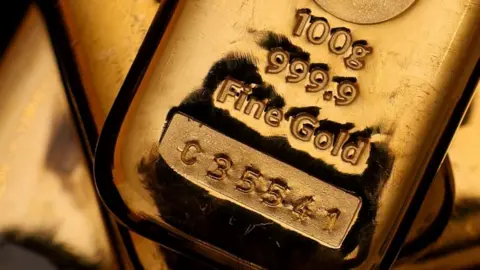
The price of gold has risen above $5,000 (£3,659) an ounce for the first time ever, extending a historic rally that saw the precious metal jump by more than 60% in 2025.
This surge comes amid increasing tensions between the US and NATO over Greenland, contributing to heightened concerns about financial and geopolitical instability.
US President Donald Trump's trade policies have added to market anxieties, especially after he threatened to impose a 100% tariff on Canada if it strikes a trade deal with China.
Gold and other precious metals are regarded as safe-haven assets, attracting investors during periods of instability. On the same day, silver topped $100 an ounce for the first time, following an almost 150% rise last year.
Several factors drive the demand for precious metals, including higher inflation rates, a weak US dollar, global central banks' increased buying, and expectations of further interest rate cuts by the US Federal Reserve this year.
Moreover, ongoing conflicts in Ukraine and Gaza, coupled with the US's actions regarding Venezuelan President Nicolás Maduro, have propelled gold prices further.
Gold's attraction lies in its scarcity; only about 216,265 tonnes have ever been mined, with the World Gold Council estimating another 64,000 tonnes can still be extracted. The appeal of gold comes from the fact that it is not tied to debts or performance of a company, making it a reliable diversifier in uncertain economic conditions.
'People go to gold'
Gold experienced its most significant annual gain since 1979 in 2025, with investors gravitating toward precious metals amidst market upheaval caused by tariffs and concerns over overvalued tech stocks.
Market analysts highlight that gold's price tends to rise during periods when lower interest rates are expected, as they make other investments like bonds less appealing.
Simultaneously, cultural practices continue to drive gold purchases; in India, gold is ceremoniously bought during festivals like Diwali, reflecting its significance in traditional wealth acquisition. Indian households reportedly hold gold worth $3.8 trillion, representing 88.8% of the country's GDP.
As the year progresses, while demand for gold remains strong, analysts caution against an unpredictable market, where positive global news might dampen gold's appeal. Nevertheless, the ongoing cultural significance and financial shifts assure gold's relevance as a cornerstone of investment and tradition.