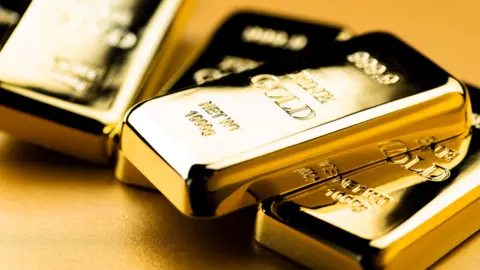
Gold prices have reached record highs recently, with investors piling money into the safe haven asset amid rising global political uncertainty. Gold surged past the $5,000 per ounce mark for the first time, briefly hitting $5,500 before falling back slightly in recent days. Silver prices have also increased significantly, trading at around $98 per ounce, up from $35 a year ago.
Despite the slight retreat, gold continues to attract investors seeking refuge amidst geopolitical tensions, instability in U.S. trade policies, and central bank purchasing. Emma Wall, chief investment strategist at Hargreaves Lansdown, notes that Trump's trade policies have worried investors, contributing to the gold rally.
Geopolitical crises, including the wars in Ukraine and Gaza, along with the U.S. seizure of Venezuelan assets, have heightened market volatility and prompted a shift towards gold as a safe investment. Wall explains that fresh tensions between the U.S., Canada, and China, and ongoing concerns regarding fiscal policies under Trump, have further bolstered gold’s appeal.
Central banks have also increased their gold purchases, viewing it as a safeguard against U.S. policy dependency. While demand has softened in 2025, countries are favoring gold as a more stable reserve asset compared to the dollar, especially after witnessing Russia’s asset seizures.
Despite its meteoric rise, gold prices have recently seen a dip due to speculation around the nomination of a new Federal Reserve chairman, which has eased upward price pressure. Nevertheless, gold remains approximately 65% higher than last year, reflecting investor behavior influenced by ongoing global conflicts and inflation hedges. This emphasizes the nature of gold as both a safe haven and a volatile investment, capable of rapid fluctuations in value.
Despite the slight retreat, gold continues to attract investors seeking refuge amidst geopolitical tensions, instability in U.S. trade policies, and central bank purchasing. Emma Wall, chief investment strategist at Hargreaves Lansdown, notes that Trump's trade policies have worried investors, contributing to the gold rally.
Geopolitical crises, including the wars in Ukraine and Gaza, along with the U.S. seizure of Venezuelan assets, have heightened market volatility and prompted a shift towards gold as a safe investment. Wall explains that fresh tensions between the U.S., Canada, and China, and ongoing concerns regarding fiscal policies under Trump, have further bolstered gold’s appeal.
Central banks have also increased their gold purchases, viewing it as a safeguard against U.S. policy dependency. While demand has softened in 2025, countries are favoring gold as a more stable reserve asset compared to the dollar, especially after witnessing Russia’s asset seizures.
Despite its meteoric rise, gold prices have recently seen a dip due to speculation around the nomination of a new Federal Reserve chairman, which has eased upward price pressure. Nevertheless, gold remains approximately 65% higher than last year, reflecting investor behavior influenced by ongoing global conflicts and inflation hedges. This emphasizes the nature of gold as both a safe haven and a volatile investment, capable of rapid fluctuations in value.