In brief
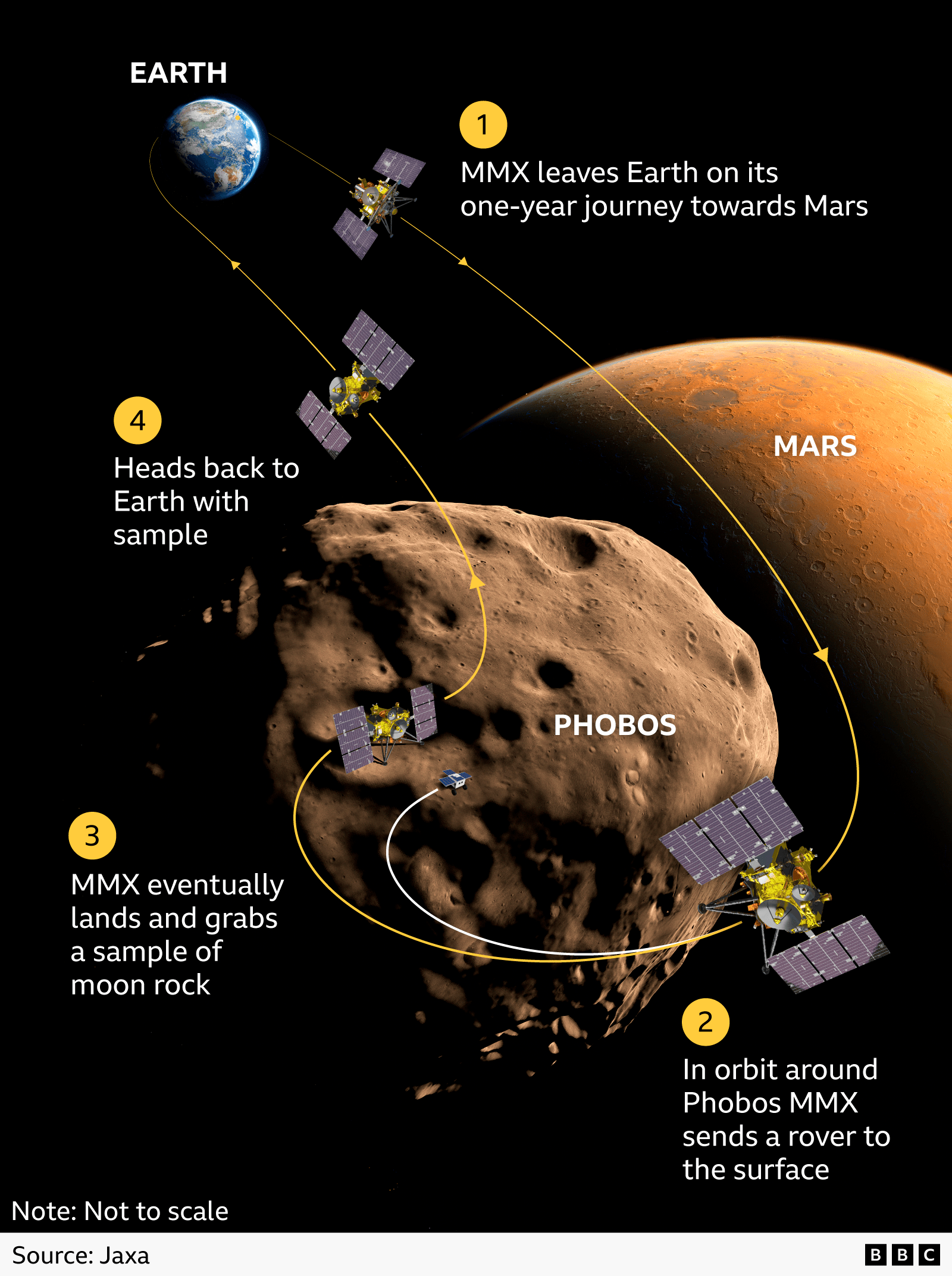
A JAXA spacecraft departed Japan on 18 October 2026 heading for Phobos, the larger of Mars’ two small moons. The mission will land a tiny rover, collect 10 grams of dust, and return it to Earth in 2031 for detailed scientific analysis. The samples are expected to decisively test competing theories about whether the moons formed from a Mars impact or were captured asteroids. The mission also offers a chance to recover Martian material implanted on Phobos during impacts, providing a rare, pristine look at Mars itself.
On 18 October 2026, the Japanese Space Agency (JAXA) launched the Mars Moons Exploration (MMX) spacecraft from Tanegashima, Japan. The probe is on a trajectory that will take it to Phobos, the larger of Mars’ two small moons, in August 2027.
MMX will first fly past Mars, study the surface of the smaller moon Deimos, and then land a miniature rover on Phobos. The rover will search for a suitable landing site and, once settled, deploy a robotic arm with two sample cartridges to collect dust from the moon’s uneven regolith.
The spacecraft will store about 10 grams of collected material in a sealed capsule that will return the dust to Earth in 2031, landing in the Woomera desert of South Australia. Though the sample is tiny, scientists emphasize that individual grain analyses can yield high‑resolution insights into composition and history.
The mission’s primary scientific goal is to resolve the long‑standing mystery of Phobos and Deimos’ origins: are they fragments from a catastrophic impact on Mars, or captured asteroid‑size bodies from the outer solar system? Chemical and mineralogical data from the returned samples will directly test these competing hypotheses.
Additional excitement stems from the possibility that Phobos has incorporated Martian material shed during impacts on Mars’ surface. If the returned dust contains grains from Mars itself, it could provide a rare, unaltered view of the planet’s interior composition.
This launch also marks the first time anyone will ship a sample from a Martian moon back to Earth, following years of storage of rover‑collected material at NASA’s Perseverance mission. The success of MMX could open the door for future sample‑return missions from Mars and its moons.