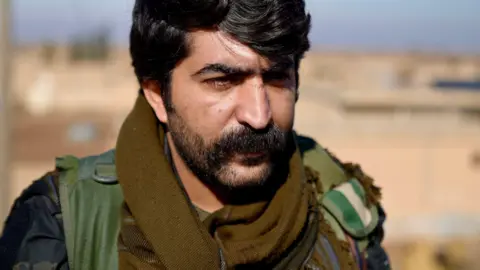
As a veteran Syrian Kurdish fighter, Commander Azad – whose nom-de-guerre means freedom - walks with a limp and wears his battle scars with pride. 'My leg was injured when we were bombed by a Turkish warplane in 2018,' he says. 'And this was shrapnel from a suicide bomber.' His injuries reveal a past entwined with conflict, yet his most profound wound stems from what he perceives as betrayal by former allies, notably the United States, who partnered with Kurdish forces in the fight against ISIS.
In a fierce display of resolve, Azad states, History will hold them accountable. Morally it's not right. But we will keep fighting until our last breath. We are not cry-babies. Currently, Kurdish leadership faces new threats from the Syrian government, which seeks to assert control over all of Syria, including Kurdish areas.
In recent weeks, government troops have successfully pushed the Kurdish-led Syrian Democratic Forces (SDF) out of several resource-rich territories, marking a significant escalation in the ongoing struggle. The conflict reflects broader geopolitical failures and the fragility of alliances, with many Kurds feeling deeply abandoned after the pivotal role they played in the defeat of ISIS.
The urgency of the situation is accentuated by the proximity of Syrian government forces, creating a tense environment with potential for renewed hostilities. Despite efforts towards a ceasefire, if violence erupts, the consequences are expected to ripple far beyond these contested regions, impacting thousands detained in Kurdish-run prisons which house remnants of the ISIS combatants and their families.
Ali of the People's Protection Units (YPG) insists, 'We are focusing all our efforts on reaching a permanent ceasefire or a lengthy one. We don't want war, but if we are forced down that path we will fight back.' The stakes remain high as Kurdish forces gather their strength, still haunted by the casualties from the ISIS conflict and resolute in their quest for autonomy in a precarious future.
In a fierce display of resolve, Azad states, History will hold them accountable. Morally it's not right. But we will keep fighting until our last breath. We are not cry-babies. Currently, Kurdish leadership faces new threats from the Syrian government, which seeks to assert control over all of Syria, including Kurdish areas.
In recent weeks, government troops have successfully pushed the Kurdish-led Syrian Democratic Forces (SDF) out of several resource-rich territories, marking a significant escalation in the ongoing struggle. The conflict reflects broader geopolitical failures and the fragility of alliances, with many Kurds feeling deeply abandoned after the pivotal role they played in the defeat of ISIS.
The urgency of the situation is accentuated by the proximity of Syrian government forces, creating a tense environment with potential for renewed hostilities. Despite efforts towards a ceasefire, if violence erupts, the consequences are expected to ripple far beyond these contested regions, impacting thousands detained in Kurdish-run prisons which house remnants of the ISIS combatants and their families.
Ali of the People's Protection Units (YPG) insists, 'We are focusing all our efforts on reaching a permanent ceasefire or a lengthy one. We don't want war, but if we are forced down that path we will fight back.' The stakes remain high as Kurdish forces gather their strength, still haunted by the casualties from the ISIS conflict and resolute in their quest for autonomy in a precarious future.