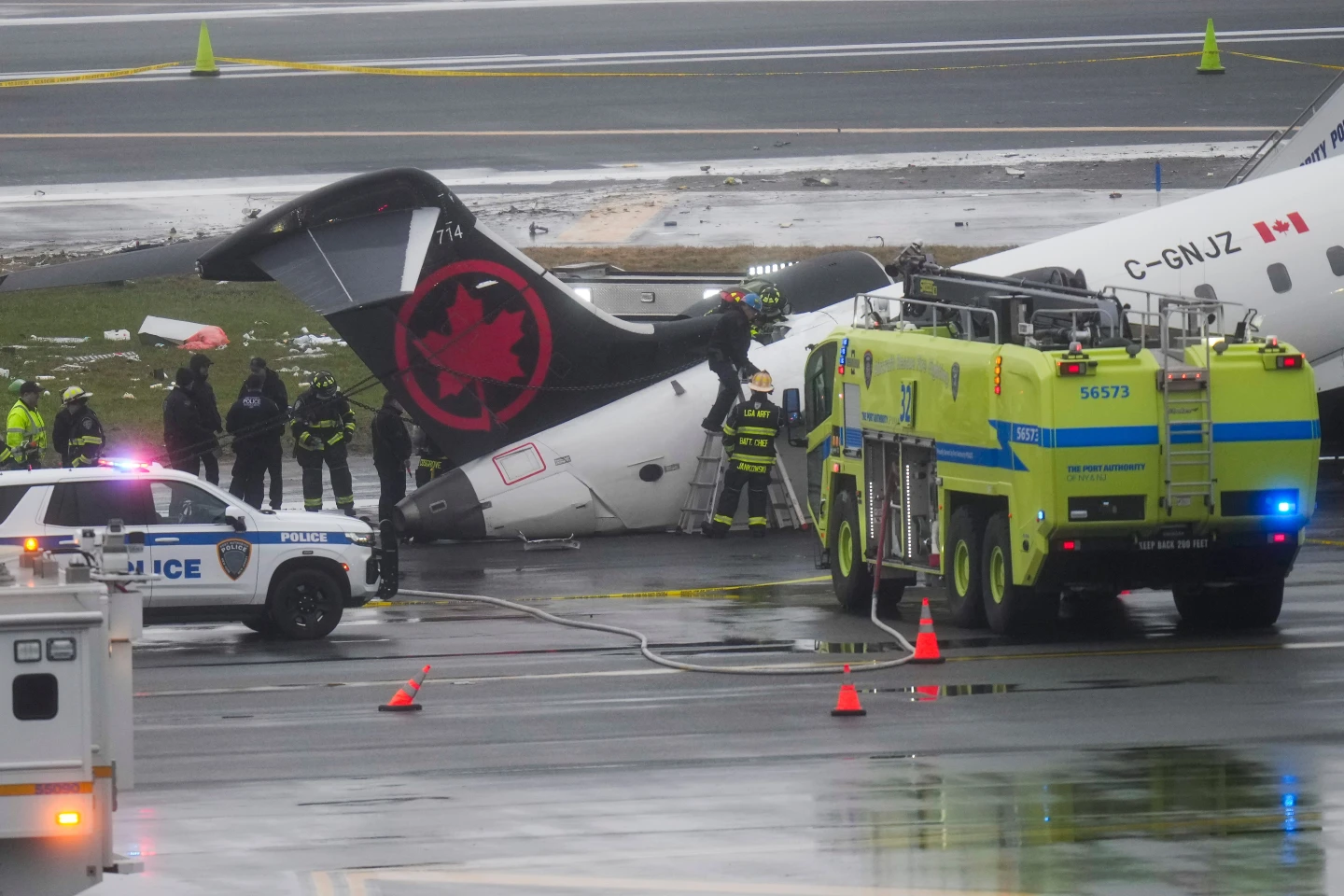
On Thursday, federal investigators presented a detailed account of the failures that culminated in the deadly March 22 collision between an Air Canada Express regional jet and a fire truck at New York's LaGuardia Airport.
The National Transportation Safety Board's preliminary report illustrated critical errors including the fire truck's disregard for a stop signal and failure to utilize a transponder, thus hampering safety alerts. On the night of the accident, heavy air traffic compounded the situation, as controllers worked under increased pressure due to simultaneous emergencies.
The crash occurred shortly after Air Canada Express Flight 8646, carrying 76 passengers from Montreal, landed. Tragically, pilots Antoine Forest, 30, and Mackenzie Gunther, 24, lost their lives, while 39 others, including the fire truck crew, sustained injuries.
The incident marked LaGuardia's first fatal accident in 34 years. The published report outlined several crucial findings:
Intense Workload for Controllers
On the night of the incident, with only two air traffic controllers managing a surge in arrivals and departures, the workload escalated dramatically. The airport recorded more than double the expected post 10 p.m. traffic due to delays, resulting in planes landing in quick succession while simultaneously addressing an emergency on a departing United Airlines flight.
Experts have commented on the untenable situation these controllers faced, stating that the operational demands were overwhelming.
Absence of Critical Technology
LaGuardia boasts an advanced surface surveillance system intended to mitigate collision risks through radar and transponder data. However, the involved fire truck, alongside others in its convoy, were deficient in transponder equipment, undermining this safety network.
Warning Signals Ignored
As the Air Canada flight approached landing, secondary communications between air traffic controllers led to the fire truck receiving clearance to cross the active runway, despite illuminated warning signals indicating otherwise.
The crucial automated warning lights remained active until just moments before the crash, causing confusion and potentially damaging judgment under duress. Aviation safety experts emphasized the essential nature of adhering to these signals regardless of clearance from controllers.
Communication Breakdowns
In the final moments before the collision, the air traffic controller urgently instructed the fire crew to stop their approach. Disarray in communication clarity left the truck's crew uncertain of the immediate directives, exacerbating the time-sensitive circumstances.
Investigators noted that the fire truck had likely reached speeds of nearly 29 mph, leading to insufficient braking distance, despite an attempt to halt its approach.
As the investigation continues, these findings highlight the critical vulnerabilities in aviation safety measures, particularly during heightened operational stress, urging immediate reforms in both technology and protocols to avert future tragedies.