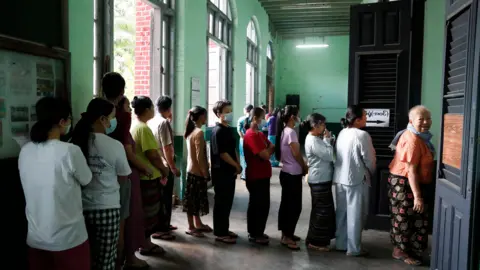
The first of three phases of voting has finished in Myanmar, in an election widely dismissed as a sham, with major political parties dissolved, leaders jailed, and as much as half the country not expected to vote due to an ongoing civil war.
The military government is holding a phased ballot nearly five years after it seized power in a coup, prompting widespread opposition and spiraling into civil war.
Observers say the junta, with China's support, is seeking to legitimise its power as it seeks a way out of the devastating stalemate.
More than 200 people have been charged for disrupting or opposing the polls under a new law which carries severe punishments, including the death penalty.
During the first round of voting, reports indicated explosions and airstrikes throughout multiple regions. A rocket attack in the Mandalay region injured several individuals, while explosions in Myawaddy township resulted in injuries and at least one fatality.
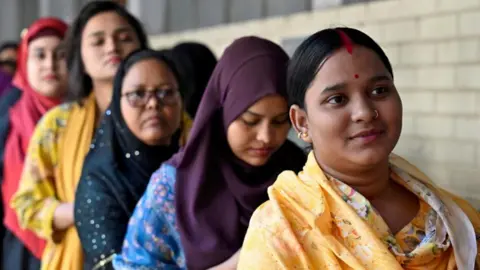
Despite the turmoil, some voters expressed a desire to participate in the electoral process. Ma Su ZarChi from Mandalay noted, The experience of voting has changed a lot... Now that I have voted, I feel relieved.
First-time voter Ei Pyay Phyo Maung commented on her civic duty, hoping for improved conditions for the lower classes facing rising living costs.
Junta chief Min Aung Hlaing defended the elections, insisting they are designed to return Myanmar to a multi-party democracy. However, many people, including UN representatives, have condemned the elections as illegitimate, with Tom Andrews, a UN Special Rapporteur, calling it a theatre of the absurd performed at gunpoint.
As fighting continues, the military struggles with severe resistance alongside ethnic militias, causing a humanitarian crisis that has displaced millions. This election process, seen as fractious, aims to divide voting into three phases, impacting turnout and strategic decisions based on initial results.
With only 265 of the 330 townships participating in the polls, many areas remain inaccessible for voting. The situation remains complex as many citizens remain skeptical about the military's governance abilities, harking back to a time when democracy felt more achievable.