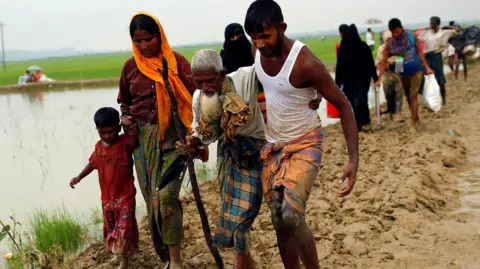
Myanmar has denied committing genocide against the Rohingya people as it began its defense at the UN's top court, the International Court of Justice (ICJ). The government representative, Ko Ko Hlaing, stated that the allegation by The Gambia was 'unsubstantiated.' Earlier, The Gambia's foreign minister, Dawda Jallow, accused Myanmar of attempting to erase the minority Muslim population through 'genocidal policies.' Thousands of Rohingya were killed, and more than 700,000 fled to neighboring Bangladesh during an army crackdown in 2017. This has led to severe humanitarian crises for the displaced Rohingya, with many currently living in refugee camps. The Gambia launched its case against Myanmar in 2019, motivated by its own historical context with military governance. The hearing at the ICJ is being closely observed, as the outcome could influence other international cases and redefine the legal understanding of genocide.
Myanmar's Defence Begins in Landmark Genocide Case at ICJ
Myanmar's Defence Begins in Landmark Genocide Case at ICJ
As Myanmar stands accused of genocide against the Rohingya people, the International Court of Justice hears arguments from both sides, with the country's representation denying the allegations.
Myanmar commenced its defence in a high-profile genocide case at the International Court of Justice, refuting The Gambia's claims of systematic genocide against the Rohingya. The country's officials argue that operations targeting the Rohingya were in response to insurgent threats, with more than 700,000 people having fled to Bangladesh during military crackdowns in 2017. The ICJ is set to hear evidence from witnesses shortly, with a final ruling anticipated by the end of 2026.