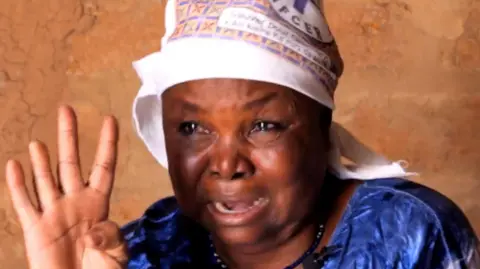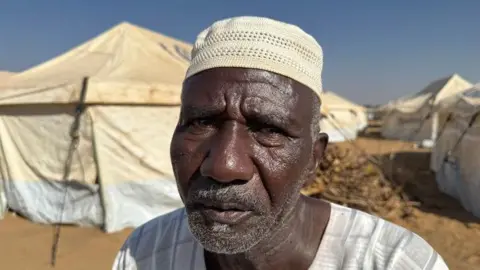
An elderly Sudanese man named Abdulqadir Abdullah Ali recounted the terrifying moments when he fled from the violent siege of el-Fasher, expressing disbelief at his ability to escape despite suffering from significant health issues. As paramilitary forces stormed the city, he described the atmosphere filled with chaos and fear, where families scattered in all directions, desperately trying to escape the violence.
The morning the RSF came there were bullets, many bullets, and explosives going off, Ali explained. People were out of control [with fear], they ran out of their houses, and everyone ran in different directions, the father, the son, the daughter - running.
The takeover of el-Fasher marks a dire escalation in the conflict that has already claimed thousands of lives over the past 18 months. Recent months saw the Rapid Support Forces (RSF) overpower the Sudanese army, leading to widespread atrocities against fleeing civilians. As armed men targeted the elderly and children, gripped with terror, survival became the singular focus.
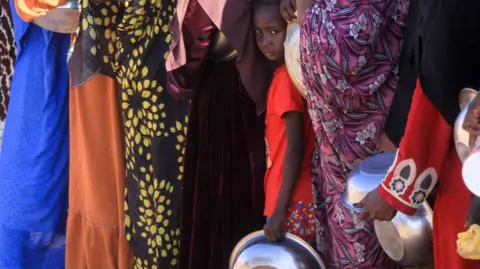
Reports from those who managed to escape to a tent camp in northern Sudan document an alarming pattern of violence, with survivors recounting instances of direct shootings and even cars driven over the wounded. Ali represented a grim witness to these actions, stating, Some of the RSF came with their cars. If they saw someone was still breathing, they drove over them.
Many stories told in the camp expose the haunting realities of those escaping the conflict. Families were torn apart, with children and parents separated by gunfire and chaos. Women reported that RSF fighters engaged in sexual violence during the conflict, further compounding the trauma. Aid organizations warn that many fleeing el-Fasher are still unaccounted for, and the UN deems it as one of the darkest times in the region's history.
As international attention begins to pivot towards an urgent humanitarian response, those in the camps hold onto a semblance of hope for safety and recovery. We can live and rest, Ali concluded, highlighting the indomitable spirit of those through untold suffering.
The morning the RSF came there were bullets, many bullets, and explosives going off, Ali explained. People were out of control [with fear], they ran out of their houses, and everyone ran in different directions, the father, the son, the daughter - running.
The takeover of el-Fasher marks a dire escalation in the conflict that has already claimed thousands of lives over the past 18 months. Recent months saw the Rapid Support Forces (RSF) overpower the Sudanese army, leading to widespread atrocities against fleeing civilians. As armed men targeted the elderly and children, gripped with terror, survival became the singular focus.
Reports from those who managed to escape to a tent camp in northern Sudan document an alarming pattern of violence, with survivors recounting instances of direct shootings and even cars driven over the wounded. Ali represented a grim witness to these actions, stating, Some of the RSF came with their cars. If they saw someone was still breathing, they drove over them.
Many stories told in the camp expose the haunting realities of those escaping the conflict. Families were torn apart, with children and parents separated by gunfire and chaos. Women reported that RSF fighters engaged in sexual violence during the conflict, further compounding the trauma. Aid organizations warn that many fleeing el-Fasher are still unaccounted for, and the UN deems it as one of the darkest times in the region's history.
As international attention begins to pivot towards an urgent humanitarian response, those in the camps hold onto a semblance of hope for safety and recovery. We can live and rest, Ali concluded, highlighting the indomitable spirit of those through untold suffering.