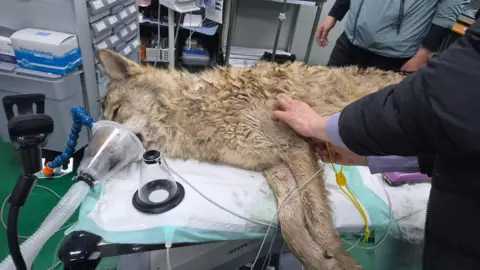
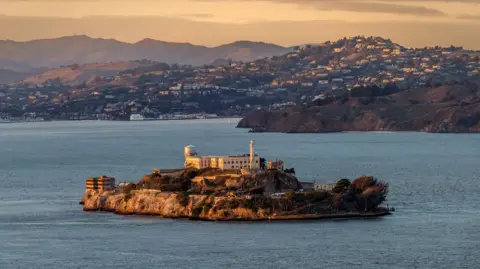
A lone coyote that swam more than a mile across the San Francisco Bay to Alcatraz Island is being monitored by scientists and could be moved if its presence threatens birds on the infamous Californian island.
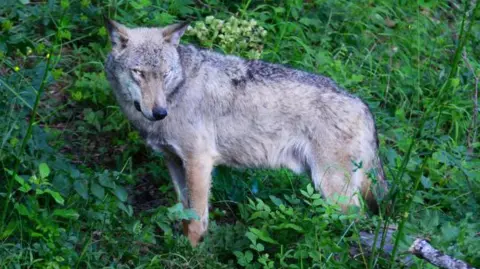
The canine, called Floyd, appears to be thriving on The Rock - renowned for its abandoned prison - and getting by on an avian diet.
Whether Floyd can stay on Alcatraz depends entirely on how it behaves, says Aidan Moore, a local tour guide who shared footage of the coyote's journey.
Complicating matters, he adds, is that there are no fresh water sources, which could make the animal's welfare dependent on human intervention.
Video footage of Floyd - believed to be a male - hopping onto Alcatraz's rocks was captured by a tourist and shared with Moore.
The gaunt coyote appeared to be shivering from the bay water which is about 10C (50F). But he has plumped up since, says Moore, who is originally from the Cotswolds, England.
On Saturday, the Golden Gate National Recreation Area (GGNRA) observed and photographed the coyote, confirming that it is believed to be the same coyote seen swimming to and coming ashore on the island nearly two weeks earlier.
Floyd is the first documented coyote presence on Alcatraz since the island was transferred to the National Park Service in 1972, the GGNRA said.
Park biologists and staff are actively monitoring the coyote to better understand how it is surviving on the 22-acre (89,030m) island and to assess any potential impacts to the seabird breeding colony, the GGNRA said.
The coyote's presence does not affect public access to the island, which remains open to visitors.
Alcatraz Island - nicknamed the Rock because it was regarded as an impregnable fortress - is home to the shuttered federal penitentiary that housed some of the most dangerous criminals in the US.
Coyotes, native to North America, are not uncommon in the San Francisco Bay.
According to Moore, nearby Angel Island has at least 16 coyotes thriving there due to fresh water and larger prey.
For Floyd, catching enough birds to survive is crucial, and he may stay hydrated with rain puddles, says Janet Kessler, a naturalist observing coyote behavior.
Experts suggest Floyd's journey might stem from population pressure in the city pushing him to find a new territory.
While coyotes are adaptable, tour guide Moore is concerned about Floyd's future and advocates for human intervention, though finding him may prove challenging.
Project Coyote, focusing on educating about coexistence with coyotes, highlights the importance of safeguarding both the animal and human visitors on the island as perceptions of this unique situation unfold.