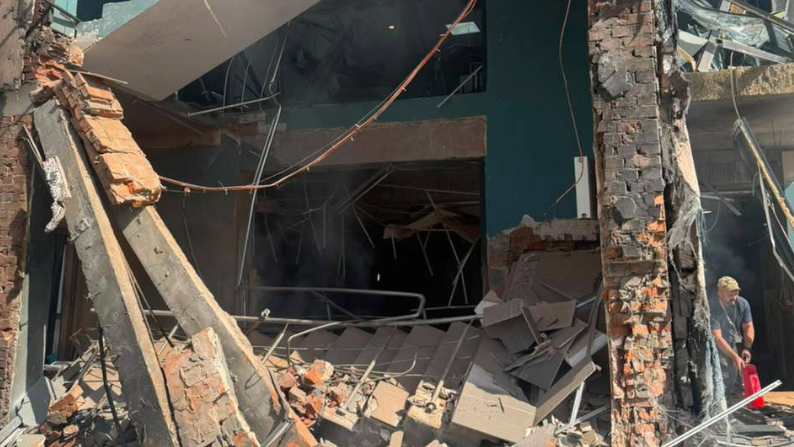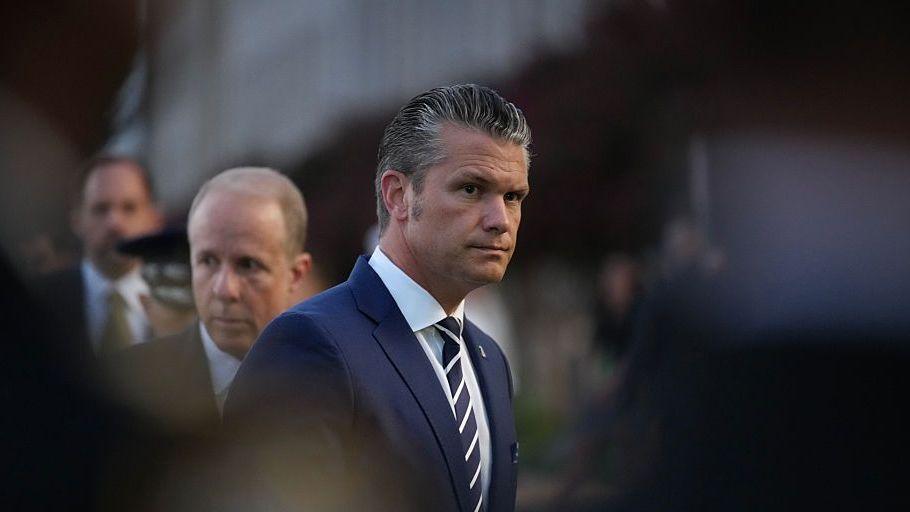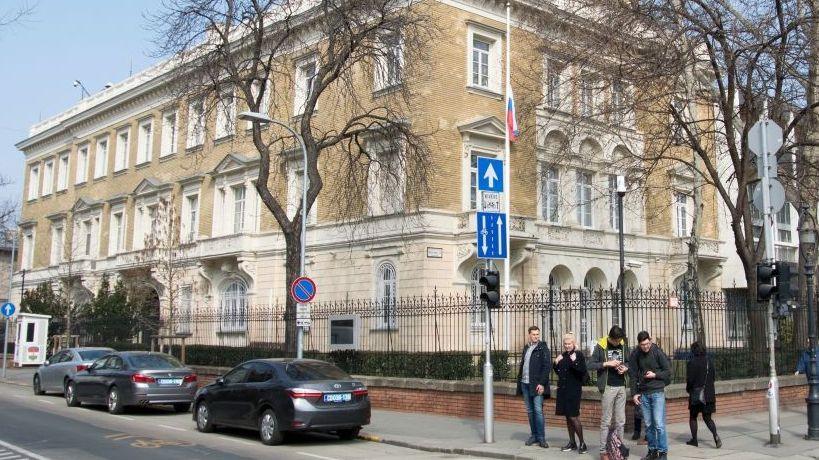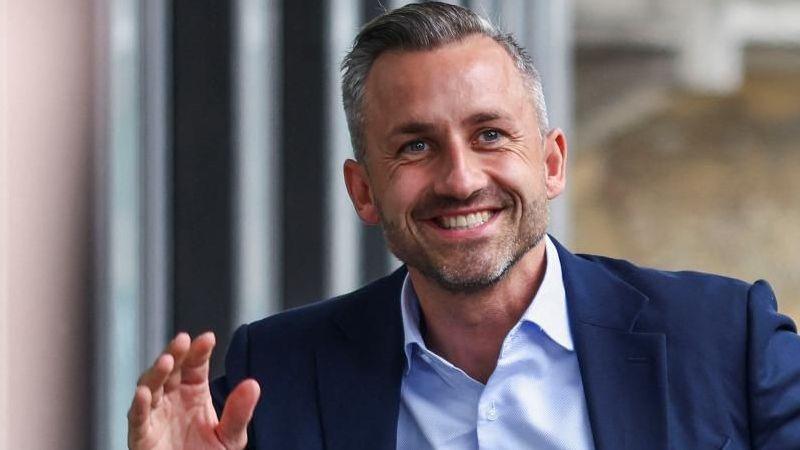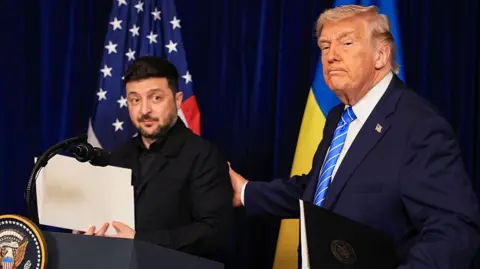
Russia, the US and Ukraine agree that a deal on ending almost four years of full-scale war is edging closer but, in the words of President Donald Trump, one or two very thorny, very tough issues remain.
Two of the trickiest issues in Washington's 20-point plan involve territory and the fate of Europe's biggest nuclear plant, which is currently occupied by Russia.
The Kremlin agrees with Trump that negotiations are at a final stage, and Zelensky's next step is to meet European leaders in France on 6 January, but any one of the sticking points could jeopardise a deal.
Fate of Ukraine's industrial heartland coveted by Putin
Vladimir Putin has not budged from his maximalist demand for the whole of Ukraine's industrial Donbas, although Ukraine's Volodymyr Zelensky has offered a compromise.
Russian forces occupy most of the Luhansk region in the east but little more than 75% of Donetsk, and Putin wants it all, including the remaining fortress belt cities of Sloviansk and Kramatorsk.
We can't just withdraw, it's out of our law, says Zelensky. It's not only the law. People live there, 300,000 people... We can't lose those people.
He has proposed Ukrainian forces pull back from the area to create a demilitarised or free economic zone policed by Ukraine, if the Russians pull back the same distance too. The current line of contact would then be policed by international forces.
It is difficult to imagine Putin agreeing to any of that, and Russia's generals have told him they are capturing Ukrainian territory fast.
If the authorities in Kyiv don't want to settle this business peacefully, we'll resolve all the problems before us by military means, Putin has claimed.
Both sides are widely seen as suffering from exhaustion, and analysts from the Institute for the Study of War have estimated it would take Russian forces until August 2027 to conquer the rest of Donetsk if they are able to maintain their current rate of advance - which is not a given.
Zelensky's compromise would also require Russian troops to leave other areas of Ukrainian territory where they maintain a limited presence, including Kharkiv and Sumy region in the north, Dnipropetrovsk in the east and Myokolaiv in the south.
Without movement on Donetsk, the chance of a peace deal looks unrealistic, but a Russian compromise may not be out of the question.
Kremlin envoy Yuri Ushakov said recently it's entirely possible that there won't be any troops [in Donbas], either Russian or Ukrainian, although he was adamant the territory would be part of the Russian Federation.
Ukraine's huge nuclear power plant in Russian hands
Ever since March 2022, Russia has occupied Europe's biggest nuclear plant at Enerhodar, on the banks of the Dnipro river. But the six nuclear reactors of the Zaporizhzhia plant are not producing electricity - they have all been in cold shutdown mode for more than three years - and external power supplied by Ukraine is keeping the plant going to prevent a meltdown.
To get it going again it needs substantial investment, partly to rebuild the destroyed Kakhovka hydro-electric dam that was used to provide cooling water for the plant.
Ukraine believes the area should also become demilitarised and turned into a free economic zone.
The US proposal, according to Zelensky, is for the US to manage the plant as a joint enterprise with Russia and Ukraine. Kyiv has said that is unrealistic and instead the US and Ukraine could jointly manage it 50-50, with the US deciding where half of the power goes - by implication to Russia.
Ukraine's problem is that Russia will not let it go and the head of Russia's Rosatom nuclear agency Alexei Likachev has stressed that only one entity - Russia - can run it and ensure its safety.
He has held out the possibility that Ukraine could use electricity generated by the plant in the context of international co-operation.
Compromise on this issue may not be insurmountable, but it would require a level of trust between two neighbouring states when none exists.
Lack of mutual trust despite positive rhetoric
It is hard to imagine significant progress on the biggest sticking points when there is so little trust.
When Trump suggested this week that Putin wants to see Ukraine succeed… including supplying energy… at very low prices, Zelensky clearly did not believe a word of it - he does not consider Putin as serious about peace.
I don't trust Russians and... I don't trust Putin, and he doesn't want success for Ukraine, the Ukrainian leader said.
Russia has also shown little faith in Kyiv - accusing Ukrainian forces of targeting drones at a Putin residence in the Novgorod region, although it gave no evidence of the attack.
Ukraine denies it even happened and believes it is a Russian pretext for further Russian strikes on government buildings in Kyiv.
Other sticking points that could derail deal
Kyiv has asked the US and European leaders for security guarantees to ensure a Nato-style response in the event of a further Russian attack. Ukraine is also seeking to maintain an 800,000-strong military.
Although the US and Europe might sign up to a deal on security, Russia will not accept European troops on the ground in Ukraine.
Financial losses for Ukraine have been estimated at $800bn (£600bn), so another key issue is how much will Russia contribute to that. The US talks of a joint investment fund with Europe, and Russia has €210bn (£183bn) worth of assets in Europe that could also be used, even though Moscow has so far refused to allow it.
Russia also rejects Ukraine's bid to join Nato. That may not be too much of a sticking point as there is no likelihood yet of that happening, but it is part of Ukraine's constitution, so finding agreement will be difficult.
Membership of the European Union is also a potential sticking point, perhaps less so for Russia than for countries that are ahead of Ukraine in the queue to join the EU. Few believe it will happen very soon.
Could Ukrainians hold a vote on a deal?
The Ukrainian leader has cited opinion polls that suggest 87% of Ukrainians want peace, while at the same time 85% reject withdrawing from Donbas.
So he believes no decision on either the fate of Donetsk or the broader 20-point plan can be made without a popular vote and a 60-day ceasefire to prepare it: A referendum is the way to accept it or not accept it.
This too is a potential sticking point as the Kremlin argues a temporary ceasefire would only prolong the conflict and lead to renewed hostilities - and Trump has said he understands Putin's position.
But without such a vote Zelensky believes a deal would have no validity which just adds to the list of thorny issues to be resolved.