In brief
Russian political consultant Igor Ratchin and translator Lev Lakshtanov are on trial in Angola, accused of orchestrating disinformation campaigns and trying to manipulate the political landscape ahead of next year's presidential election. As tensions rise, the Angolan authorities allege that these operatives acted on behalf of a shadowy network with origins in the Wagner Group. Meanwhile, their defense claims insufficient evidence supports the indictment, amidst concerns that authorities may be using the case as a scapegoat for social unrest.
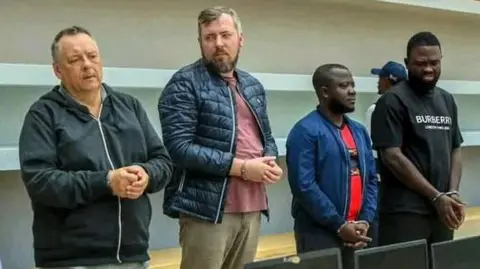
Two Russians are due to go on trial in Angola accused of stirring up anti-government protests, conducting a campaign of disinformation, and attempting to interfere in next year's presidential election.
Arrested last August, political consultant Igor Ratchin and translator Lev Lakshtanov are facing 11 charges, including terrorism, espionage, and influence peddling.
The BBC has obtained a copy of the indictment that includes charges relating to an alleged operation aimed at changing the political course of Angola. The Russians' lawyers challenge the indictment on the grounds that it lacks concrete and objective facts.
According to the prosecution, the Russians acted on behalf of Africa Politology, a shadowy network of operatives and intelligence officers that emerged from the now-defunct Wagner Group. Political operatives linked to Wagner have been active across Africa for more than a decade, particularly in the Central African Republic, Mali, and Madagascar.
The defence team asserts that Ratchin and Lakshtanov were not connected to Africa Politology, nor acting on behalf of the Russian state. They claim the two were in Angola to promote cultural relations, specifically through a proposed "Russian House" in Luanda.
Angola, a key player in global oil and diamond markets, remains a country of interest for Moscow. While historical connections date back to the Cold War, Angola has been making a gradual shift away from Russia's influence.
Russian diamond company Alrosa and bank VTB departed Angola due to international sanctions following the Ukraine war. Moreover, Angolan President João Lourenço has pivoted towards Western partnerships, distancing himself from Russian engagements since 2019.
The indictment mentions that two Angolans, journalist Amor Carlos Tomé and political activist Francisco Oliveira, are also facing trial for their alleged participation in the Russian-linked operation. They are charged with a variety of offenses, including terrorism and espionage.
The prosecution implies that the Russians coordinated with the local defendants to incite protests, referencing notes and photographs allegedly retrieved from the accused’s mobile devices as evidence. In contrast, the defence claims insufficient evidence supports these accusations.
The situation highlights not only the geopolitical interests at stake but also the serious social issues within Angola. Many locals protest against living conditions, a reality that some believe is being obscured by the emphasis on foreign operatives.
The trial represents a significant moment in Angola's political history, as officials attempt to navigate the complex interplay of international influence, local governance, and civil unrest.