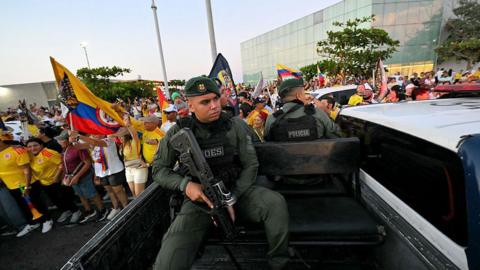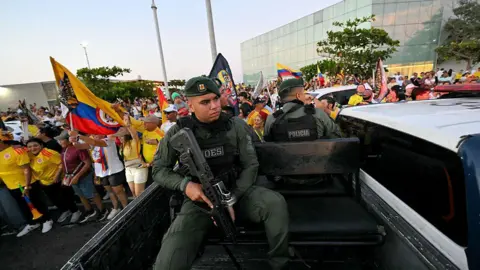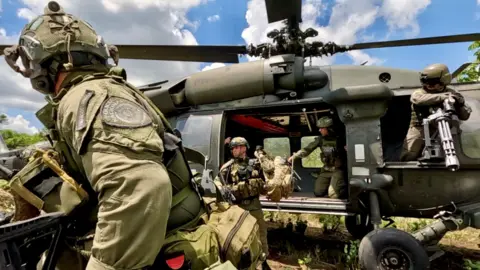
The Black Hawk helicopter was ready for take off – its rotor blades slicing through the air in the deadening heat of the Colombian Amazon. We ducked low and crammed in alongside the Jungle Commandos – a police special operations unit armed by the Americans and originally trained by Britain's SAS, when it was founded in 1989.
The commandos were heavily armed. The mission was familiar. The weather was clear. But there was tension on board, kicking in with the adrenaline. When you go after any part of the drug trade in Colombia, you have to be ready for trouble.
The commandos often face resistance from criminal groups, and current and former guerrillas who have replaced the cartels of the 1970s and 80s. We took off, flying over the district of Putumayo - close to the border with Ecuador - part of Colombia's cocaine heartland. The country provides about 70% of the world's supply.
Just ahead two other Black Hawks were leading the way. Down below us, there was dense forest and patches of bright green – the tell-tale sign of coca plant cultivation. The crop now covers an area nearly twice the size of Greater London, and four times the size of New York, according to the latest figures from the United Nations Office on Drugs and Crime (UNODC), published in 2024.
President Donald Trump has publicly criticized Colombia's left-wing President Gustavo Petro for not doing enough to prevent cocaine from arriving in the U.S., alleging that under Petro's watch, cocaine production has soared to record highs. However, Petro counters that his government has seized the largest amount of drugs in history.
The fight against drug production and trafficking will be high on the agenda when Petros meets with U.S. officials. Each successful raid against drug manufacturing facilities often leads to temporary pauses for the commandos, but they face an ever-evolving adversary; drug gangs are utilizing high-tech resources such as drones and cryptocurrencies.
Back at base, Major Cristhian Cedano Díaz acknowledged that while labs can be rebuilt in a day, the commandos are reducing the profitability of these criminal operations. He maintains that consistently targeting production deters profitability, and that is a critical part of the wider strategy against drug trafficking.
This report sheds light not only on the operational aspects of fighting drug trafficking but also the complicating factors involving the local economy. Farmers like "Javier" highlight the challenges between survival and morality, often feeling trapped in a cycle of poverty that drives them to grow coca to sustain their families.
As Colombia continues its fight against drug-related crime, the stories from the ground reveal the importance of comprehensive policies that address both the demand and supply side of the drug trade, as well as the socio-economic realities faced by those involved.