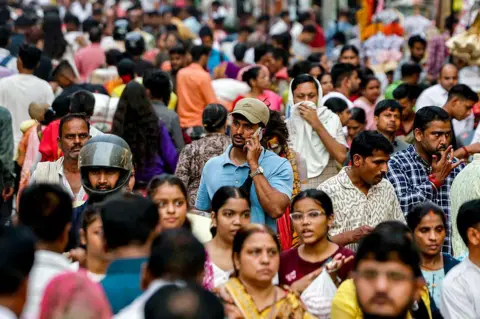
India has officially kicked off its 16th census, a monumental task that will involve more than three million enumerators who will seek to account for the vast population exceeding 1.4 billion residents. This census marks the first major population count in over 15 years, with the last survey being conducted in 2011.
The census will be executed in two phases, with the initial phase focusing on household listings and basic living conditions. Enumerators will ask about various factors including housing structure, internet access, and the number of married couples living together, among other queries, totaling 33 specific questions aimed at understanding the socio-economic landscape of the country.
With the 2021 census postponed due to the COVID-19 pandemic, this exercise holds particular importance for policymakers, social scientists, and economists eager to obtain a fresh demographic snapshot of India. The data collected this time will also include caste information, a measure that has long been a point of political contention but is considered crucial for equitable welfare distribution and representation.
As India seeks to refine its governance and resource allocations, the census represents a significant move to grasp current population dynamics amidst declining fertility rates and an increasingly youthful median age of 28.
An essential new feature of this census is the transition to digital methodologies. For the first time, residents can self-enumerate through an online portal available in multiple languages, further simplifying data collection and accuracy verification.
As this ambitious census unfolds across all states and territories, it highlights the necessity of current data to address the changing realities of India’s diverse population.
}