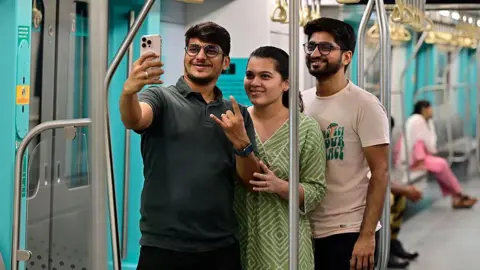
On a weekday evening last month, Mumbai's southbound Aqua Line metro train nearly emptied out a couple of stops before the final one. Upon deboarding, the last station bore the look of a desolate Soviet-era structure rather than a bustling train terminal in a city where crowds typically jostle for space. The Aqua Line is the city's new fully underground metro train connecting the old business district of Cuffe Parade to newer commercial hubs like BKC and the airport terminals in the northern suburbs, which opened last year. This 33.5km corridor was expected to ease congestion in India's financial capital and projected to carry nearly 1.5 million passengers every day. However, the actual numbers are about a tenth of that.
Not a lot of people are using the line. It's too expensive, a ticketing executive shared at Cuffe Parade station. This low ridership trend is symptomatic of larger challenges faced by India's rapidly expanding metro systems.
Since 2014, under the Narendra Modi government, India has invested over $26 billion in building metro connectivity across nearly two dozen cities, resulting in the network growing fourfold from under 300km to over 1,000km by 2025. Daily ridership has also risen from three million to over 11 million in the last decade, but these grand totals obscure troubling stats: most metro systems have failed to meet even a small percentage of the ridership predicted during planning.
Experts cite that ridership is often only 25-35% of projected figures. For example, in tier-3 cities like Kanpur, numbers are as low as 2% of estimates. In contrast, Delhi is the only major exception where usage has slightly surpassed projections, although this can be attributed to counting interchanges as separate trips.
Factors contributing to this underperformance include overly optimistic passenger projections by planners, high fares compared to alternative transportation, and lack of reliable last-mile connectivity. In Indian metros, the integrated journey cost can consume 20% of income for lower-income workers, well above the global benchmark of 10-15%. Furthermore, inadequate sidewalk and pathway infrastructure, particularly concerning women's safety, deters use.
Transportation experts suggest that better operational integration between various transport systems as well as subsidies could encourage commuter use. Until these issues are addressed, the anticipated surge in metro adoption may remain elusive, particularly as congestion and pollution problems intensify in urban realms.
Not a lot of people are using the line. It's too expensive, a ticketing executive shared at Cuffe Parade station. This low ridership trend is symptomatic of larger challenges faced by India's rapidly expanding metro systems.
Since 2014, under the Narendra Modi government, India has invested over $26 billion in building metro connectivity across nearly two dozen cities, resulting in the network growing fourfold from under 300km to over 1,000km by 2025. Daily ridership has also risen from three million to over 11 million in the last decade, but these grand totals obscure troubling stats: most metro systems have failed to meet even a small percentage of the ridership predicted during planning.
Experts cite that ridership is often only 25-35% of projected figures. For example, in tier-3 cities like Kanpur, numbers are as low as 2% of estimates. In contrast, Delhi is the only major exception where usage has slightly surpassed projections, although this can be attributed to counting interchanges as separate trips.
Factors contributing to this underperformance include overly optimistic passenger projections by planners, high fares compared to alternative transportation, and lack of reliable last-mile connectivity. In Indian metros, the integrated journey cost can consume 20% of income for lower-income workers, well above the global benchmark of 10-15%. Furthermore, inadequate sidewalk and pathway infrastructure, particularly concerning women's safety, deters use.
Transportation experts suggest that better operational integration between various transport systems as well as subsidies could encourage commuter use. Until these issues are addressed, the anticipated surge in metro adoption may remain elusive, particularly as congestion and pollution problems intensify in urban realms.