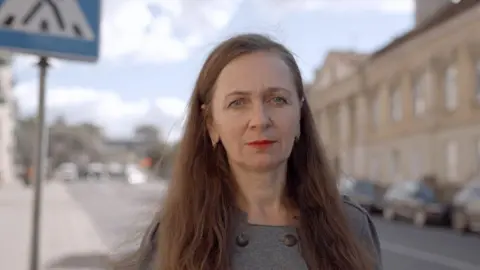
Larysa would have been happier staying in prison for the final four months of her sentence, if she could have gone home at the end of it.
Instead she was bussed over the border from Belarus into Lithuania with 51 other political prisoners. They were released in September as part of a deal to relax sanctions hatched between Belarus's authoritarian leader Alexander Lukashenko and US President Donald Trump.
During the three years she spent behind bars for 'extremism' and 'discrediting' Belarus, Larysa Shchyrakova missed her mother's funeral. Now she cannot visit her grave.
She left behind her son, her home, her dog and all her possessions. Like most of the freed prisoners, Larysa has no documents, and risks arrest if she returns.
'You lose everything overnight. It's a traumatic thought that at 52, you're essentially homeless,' she told the BBC.
In reality she had no choice. Veteran opposition politician Mikola Statkevich got off Larysa's bus and refused to cross the border. He has not been heard of since, and it is assumed he was sent straight back to jail.
Mikalai Dziadok, a 37-year-old activist, spent five years behind bars and was marked with a special yellow tag, which meant tighter control and harsher treatment.
Thousands were sent to jail in the weeks and months after Lukashenko brutally suppressed mass protests in 2020. Dziadok recalls how for months he was placed in solitary confinement with prisoners in cells on both sides shouting 'insults and threats to rape, kill, and dismember' him.
Solitary confinement is routinely used in Belarus as punishment against political prisoners for petty 'violations'. Yevgeny Merkis, a colleague of Larysa's, who was released in September, described how freezing tiny solitary cells subjected inmates to psychological torture, causing deep trauma.
'[The authorities] understood probably the overwhelming majority of us would sooner or later be released,' Dziadok noted. 'And if they had to release that person, it was necessary to traumatise him as much as possible so that he could not take part in political activity in the future.'
Despite the recent easing of sanctions by the US following the prisoner release, Mikalai Dziadok stated: 'In Belarus, everything goes in circles.' He believes that thousands of political prisoners remain incarcerated, with many charged for minor dissent.
Larysa has adjusted to her new life in Lithuania, supported largely by the local Belarusian expat community. After being parted from her son, she can finally embrace him again, marking a bittersweet reunion amidst her trauma.