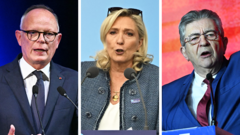
PARIS — The clock is ticking toward France's 2024 presidential election, and the nation faces a critical choice: a centrist figure who could stabilize the republic or a battle between populist extremes. Edouard Philippe, the former prime minister under Emmanuel Macron, has emerged as the only candidate positioned to prevent a far-right victory. With polls showing him as the sole realistic contender against Marine Le Pen or her National Rally deputy Jordan Bardella in the runoff, Philippe's campaign has begun cautiously, aiming to position himself as France's bulwark against radicalism.
Philippe's platform, framed by the slogan 'France Libre' (Free France), emphasizes economic conservatism: raising the retirement age to 65 and mandating balanced budgets. His team announced three campaign directors earlier this month and plans 'apartment meetings'—beaming himself into 1,000 homes—to connect directly with voters. On July 5, he will hold his first major rally in Paris. Yet, his path is fraught with uncertainty. The French electoral system demands a clear second-round showdown, but with multiple center-right contenders—including Gabriel Attal and Bruno Retailleau—philosophical differences threaten to fracture the vote. Polls suggest Philippe's rivals may prolong their campaigns to drain his support, complicating his efforts to consolidate the center.
The far-left remains a wildcard. Jean-Luc Mélenchon's 'France Unbowed' party, with its promises to dismantle billionaire media empires and tax large corporations, has built a strong base in France's immigrant-majority suburbs. While Mélenchon claims he'd face Le Pen in the runoff, polls indicate the far-right would likely prevail against him—a scenario Philippe seeks to avoid. Yet the most immediate threat to his candidacy is a corruption probe into Philippe's time as mayor of Le Havre, which his team insists is baseless.
Meanwhile, the political climate grows more volatile. Anti-elite sentiment and economic anxiety have intensified support for both Le Pen and Mélenchon, making the center appear irrelevant to many voters. Philippe, branded as a 'Macronite' by critics, faces uphill battles against a public increasingly receptive to radical change. The July 7 court ruling on Le Pen's EU funding trial could further disrupt the race—if she's barred, Bardella's youthful inexperience might backfire for the RN, but Le Pen's veteran appeal remains potent.
As Philippe's team prepares its defense, analysts note his strategy depends on three key elements: unifying the center-right, distancing voters from the far-right, and neutralizing Mélenchon. But with the election less than a year away, the question isn't just whether he can win—it's whether he can prevent a populist takeover at all. As one Parisian voter put it: 'He's the only one who can stop us from becoming the France we're afraid of.' The coming months will reveal if Philippe's 'France Libre' vision can take root—or if the extremes will dominate.}
Philippe's platform, framed by the slogan 'France Libre' (Free France), emphasizes economic conservatism: raising the retirement age to 65 and mandating balanced budgets. His team announced three campaign directors earlier this month and plans 'apartment meetings'—beaming himself into 1,000 homes—to connect directly with voters. On July 5, he will hold his first major rally in Paris. Yet, his path is fraught with uncertainty. The French electoral system demands a clear second-round showdown, but with multiple center-right contenders—including Gabriel Attal and Bruno Retailleau—philosophical differences threaten to fracture the vote. Polls suggest Philippe's rivals may prolong their campaigns to drain his support, complicating his efforts to consolidate the center.
The far-left remains a wildcard. Jean-Luc Mélenchon's 'France Unbowed' party, with its promises to dismantle billionaire media empires and tax large corporations, has built a strong base in France's immigrant-majority suburbs. While Mélenchon claims he'd face Le Pen in the runoff, polls indicate the far-right would likely prevail against him—a scenario Philippe seeks to avoid. Yet the most immediate threat to his candidacy is a corruption probe into Philippe's time as mayor of Le Havre, which his team insists is baseless.
Meanwhile, the political climate grows more volatile. Anti-elite sentiment and economic anxiety have intensified support for both Le Pen and Mélenchon, making the center appear irrelevant to many voters. Philippe, branded as a 'Macronite' by critics, faces uphill battles against a public increasingly receptive to radical change. The July 7 court ruling on Le Pen's EU funding trial could further disrupt the race—if she's barred, Bardella's youthful inexperience might backfire for the RN, but Le Pen's veteran appeal remains potent.
As Philippe's team prepares its defense, analysts note his strategy depends on three key elements: unifying the center-right, distancing voters from the far-right, and neutralizing Mélenchon. But with the election less than a year away, the question isn't just whether he can win—it's whether he can prevent a populist takeover at all. As one Parisian voter put it: 'He's the only one who can stop us from becoming the France we're afraid of.' The coming months will reveal if Philippe's 'France Libre' vision can take root—or if the extremes will dominate.}