In brief
South Korean space agency KASA recently posted a set of photographs that reveal the Moon’s surface both before and after a fragment of a SpaceX Falcon 9 rocket struck it on 6 August. The impact, caused by the upper stage that was set loose in 2025 to carry lunar landers, occurred at about 06:35 GMT. While the collision did not pose any threat to Earth, scientists warn the event highlights growing concerns over the increasing amount of orbital debris. The photographs, captured by KASA’s Danubri lunar orbiter, may provide valuable data for studying impact mechanics and surface changes on the Moon. SpaceX insists that the crash was unintentional, and experts like Cambridge astronomer Matt Bothwell emphasize that the growing population of space objects could soon make it harder to navigate beyond Earth’s orbit.
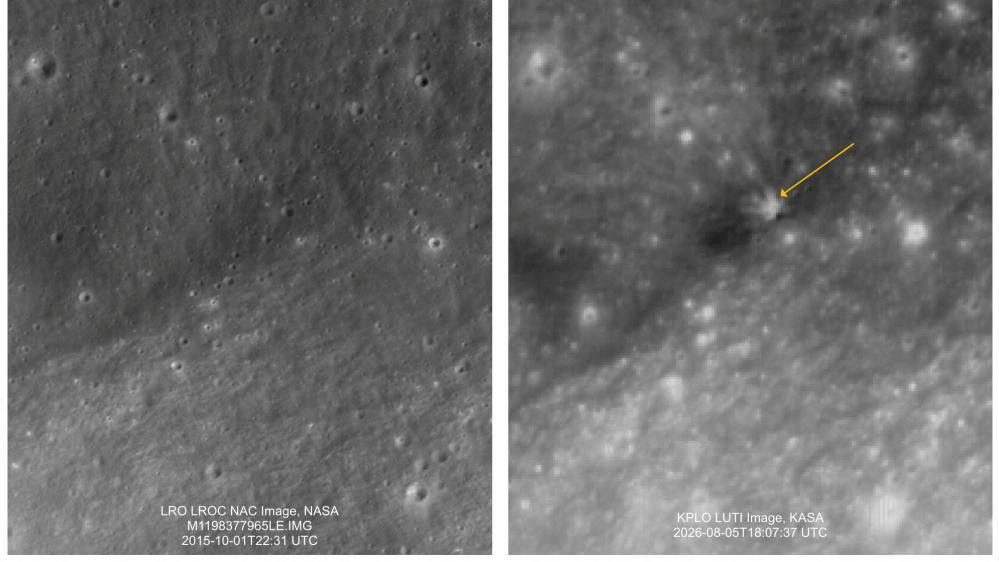
On 6 August, the Korean AeroSpace Administration (KASA) posted a set of photographs taken by its Danubri moon‑orbiting telescope that document the Moon’s surface both before and after a fragment of a SpaceX Falcon 9 upper stage impacted it.
The collision, which happened at roughly 06:35 GMT, used a spare upper stage that had been part of a 2025 mission to launch two lunar landers. The 4‑tonne segment, roughly the size of a five‑storey building, was left in a looping orbit that eventually carried it onto a trajectory heading toward the Moon.
KASA released the images via Twitter, showing the impact site in detail and offering a before‑and‑after comparison. While the impact produced only a brief flash that would hardly be seen even with high‑end telescopes, the data is already being analysed by Korean and international astronomers.
SpaceX has stated that the crash was accidental and clarified that the upper stage’s trajectory had been calculated to avoid the Moon’s surface. The event nonetheless sparked concerns on the growing population of orbital debris, with Cambridge astronomer Matt Bothwell warning that future navigation might become difficult as space “gets more and more crowded.” Cambridge University
Scientists view the incident as a unique opportunity to study the impact of large space debris on the Moon. The photos and accompanying data may inform future mission planning and debris mitigation strategies.