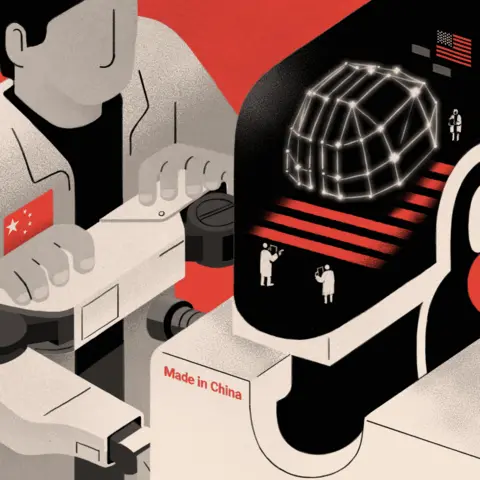
In the second half of the 20th Century, it was the race to develop nuclear arms that occupied some of the finest minds in the US and the Soviet Union.
Now the US finds itself in a different kind of race with a different adversary: China. The aim is to dominate technology; specifically Artificial Intelligence (AI).
It's a fight taking place in research labs, on university campuses, and in the offices of cutting-edge start-ups - watched over by leaders of some of the world's richest companies, and at the highest levels of government. It costs trillions of US dollars.
Each side has its strengths: the US has traditionally led with AI brains like chatbots and large language models (LLMs), while China has excelled in AI bodies, particularly humanoid robots.
However, this competitive edge may not last long as technological advancements continue to evolve rapidly. The advent of tools like OpenAI's ChatGPT and China's counter, DeepSeek, showcases pivotal moments in this race, with implications for global dominance in AI.
The US leverages its control over high-performance microchips critical for AI development, employing strict export regulations to limit access for China. Conversely, the Chinese have begun innovating independently, exemplified by their own AI initiatives like DeepSeek, which demonstrate an ability to produce competitive AI systems at a lower cost.
As both nations advance in their unique ways, observers are left to consider not just who will emerge dominant, but how these tensions will shape future global standards and the integration of AI into our daily lives.
The stakes are high: the outcome of this AI competition could determine who holds the upper hand in the 21st century, influencing economics, technology, and security worldwide.