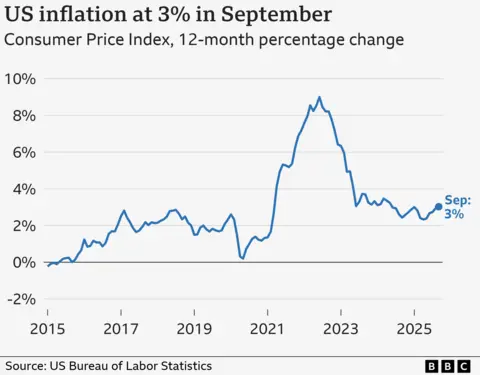
In a year filled with economic contradictions, 2025 saw strong economic growth accompanied by a decline in hiring and rising inflation, leading to an uncertainty about the future of the job market. The Federal Reserve faces an unclear economic landscape following a six-week shutdown that disrupted crucial data collection, making it difficult to gauge the true state of the economy.
Stephen Stanley, chief economist at Santander, noted, 'It is hard to say how 2025 ended.' With wealthier households increasingly responsible for spending, the economic gains mask challenges faced by lower-income families, creating what is referred to as a 'K-shaped' recovery. Economists are now questioning whether the growth will translate into job creation or if it will persist as a 'jobless expansion,' punctuated by advancing technologies such as artificial intelligence.
The contrasting segments of the economy highlight concerns: as spending continues to rise among the affluent, lower-income groups may not feel the same benefits, raising the specter of long-term economic disparity. Even though Federal Reserve governors are hopeful for an uptick in hiring backed by lower tariffs and tax benefits, the persistence of inflation coupled with uncertainty brought by technology has many cautious about projecting a solid recovery.
As 2026 unfolds, observers will closely monitor whether the economy can support job growth or if the trends observed in 2025 set a troubling precedent for the future.