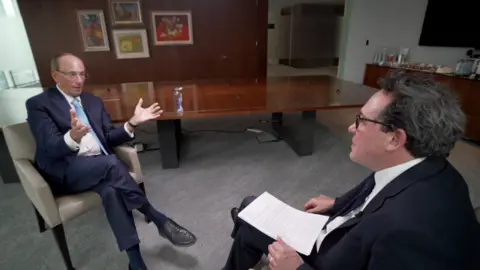
If the price of oil hits $150 a barrel, it will trigger a global recession, according to Larry Fink, the boss of US financial giant BlackRock, in an interview with the BBC.
Fink stated that if Iran continues to pose a threat and oil prices remain elevated, it would have 'profound implications' for the global economy.
BlackRock, the world’s largest asset manager with $14 trillion in assets under management, has significant insights into the trends affecting global financial markets.
Fink noted that if the geopolitical tensions ease and Iran is reintegrated into the international community, oil prices could stabilize. However, if such resolution does not occur, the market might face prolonged periods of high prices, potentially exceeding $100, and moving closer to $150, which could initiate a steep recession.
The implications of rising fuel costs extend beyond just the economic landscape; they disproportionately impact lower-income households, further widening inequality. Fink commented that energy prices act as a regressive tax that hurts poorer populations more than wealthier ones.
In addition to the energy crisis, Fink discussed the implications of artificial intelligence on employment, emphasizing the need for pragmatic energy strategies and acknowledging the potential for technology to create new jobs, particularly in trades like plumbing and electrical work.
He criticized the traditional push towards university education, suggesting that not all youths should aim for college and that technical training holds equal importance in today’s economy.
Fink dismissed concerns about a bubble in AI investments, asserting that while certain sectors may see failures, the overall growth in this field is essential for competitive stance against global rivals, particularly China.
He concluded that a diverse energy approach is critical for ensuring affordable energy as the world pivots towards increased reliance on renewable sources to sustain economic growth.