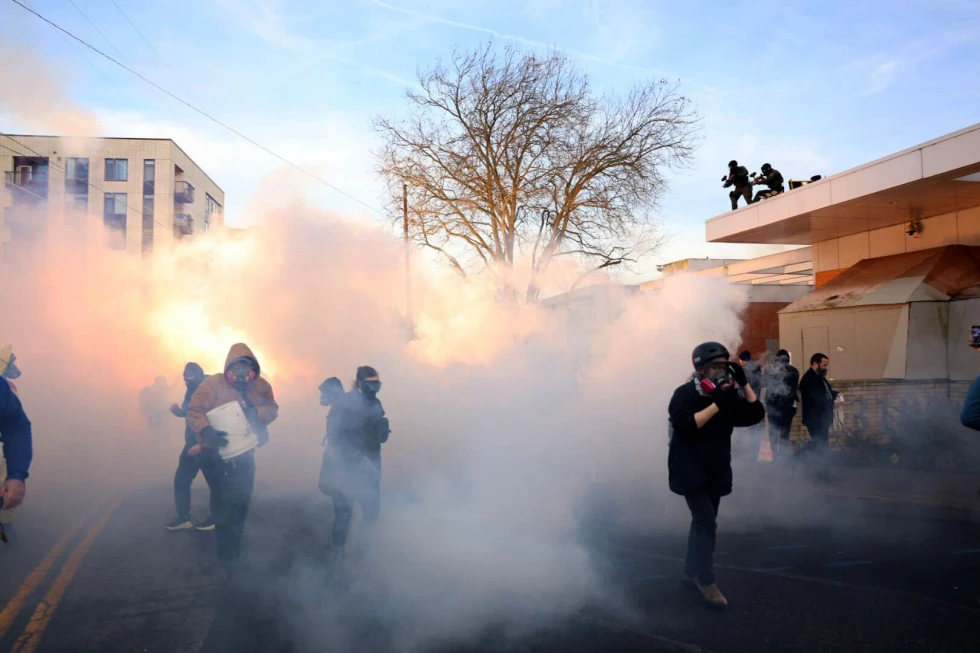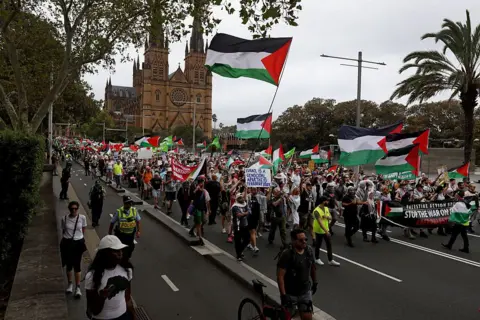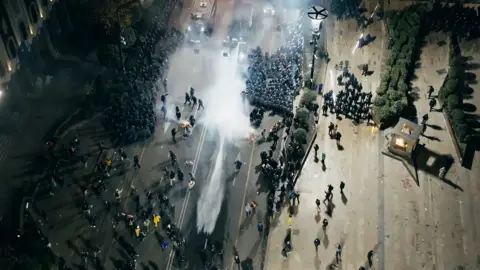
Georgia's authorities used a World War One-era chemical weapon to quell anti-government protesters last year, evidence gathered by the BBC suggests.
You could feel [the water] burning, one of the protesters said of water cannon turned on him and others on the streets of the capital Tbilisi. A sensation, he said, which could not immediately be washed off.
Demonstrators against the Georgian government's suspension of its European Union accession bid have complained of other symptoms too - shortness of breath, coughing, and vomiting that lasted for weeks.
The BBC World Service has spoken to chemical weapons experts, whistleblowers from Georgia's riot police, and doctors, and found the evidence points to the use of an agent that the French military named camite.
The Georgian authorities said our investigation findings were absurd and the police had acted legally in response to the illegal actions of brutal criminals.
Camite was deployed by France against Germany during World War One. There is little documentation of its subsequent use, but it is believed to have been taken out of circulation at some point in the 1930s, because of concerns about its long-lasting effects. CS gas - often referred to as tear gas - was used as a replacement.
Konstantine Chakhunashvili was one of those who gathered outside Georgia's parliament in Tbilisi during the first week of protests - which began on 28 November 2024. Demonstrators were incensed by the ruling party's announcement that it was pausing EU accession talks. The goal of EU membership is enshrined in Georgia's constitution.
Georgia's police responded with a variety of riot-control measures including the use of water cannon, pepper spray and CS gas.
Dr Chakhunashvili, a paediatrician who was among those sprayed by the cannons, and who has taken part in many of the demonstrations, said his skin felt like it was burning for days, and the sensation couldn't be washed away. In fact, he said, it was worse when trying to wash it off.
Dr Chakhunashvili wanted to find out if others had suffered similar effects. So he appealed, via social media, for those also targeted by crowd control measures during the first week of the demonstrations to fill out a survey. Nearly 350 people got in touch, and almost half said they had suffered one or more side-effects for more than 30 days.
These long-term symptoms ranged from headaches, to fatigue, coughs, shortness of breath and vomiting.
His study has since been peer reviewed and has been accepted for publication by Toxicology Reports, an international journal.
Based on the results of Dr Chakhunashvili's study, victim testimony, the riot police inventory, and Mr Shergelashvili's account of the chemical tests, Prof Holstege believes that this is the case. Based on the available evidence… the clinical findings reported by both those exposed and by other witnesses are consistent with bromobenzyl cyanide.
He ruled out the likelihood of the symptoms being caused by more conventional crowd control measures, such as CS gas, which was also being deployed by Georgia's riot police last year.
The persistence of the clinical effects… is not consistent with the typical agents used for crowd dispersal, such as CS, he said.
I've never seen camite being utilised in modern society. Camite is markedly irritating [and] persistent with its irritation.
Georgia's authorities described our findings as deeply frivolous and absurd. It said that law enforcement had acted within the bounds of the law and constitution when responding to the illegal actions of brutal criminals.
The protests on Tbilisi's Rustaveli Avenue have dwindled in their size since the government increased fines and jail terms, but not in their frequency.
Almost every night for the past year, demonstrators have called for the resignation of a government they accuse of rigging elections, siding with Russian interests, and passing increasingly draconian legislation against civil society.